

The AI Buildout Has to Happen Somewhere
Who gets the next AI dollar if demand keeps rising but power, permits and financing cannot keep up? At All-In Summit, we followed that question from the stage into six off-stage conversations. This report separates what the CEOs put on the record from what still needs a filing or a number.
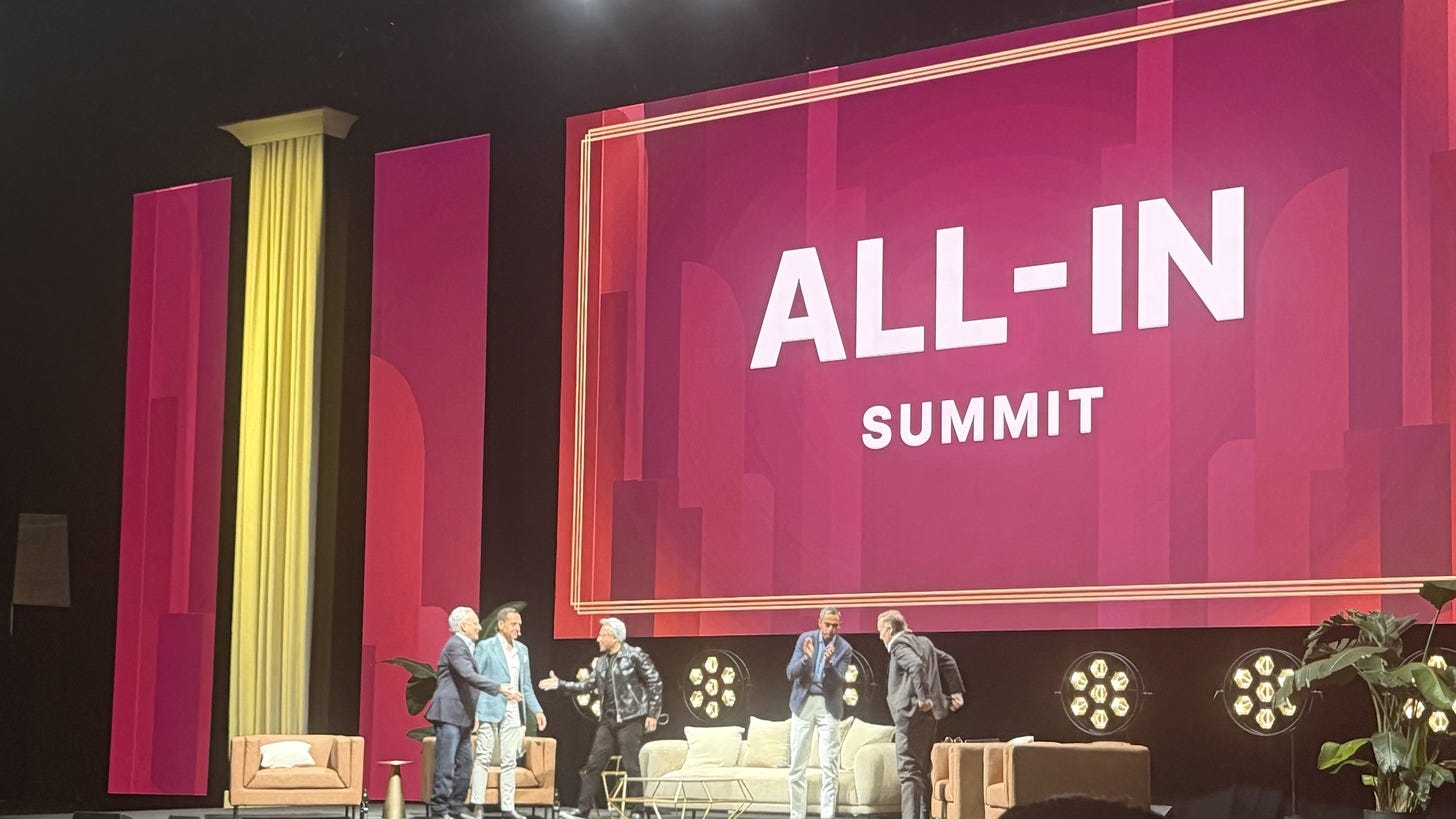
At The Shrine in Los Angeles, Monday’s debate followed Dario Amodei’s September 12 essay, “We Must Pace the Frontier,” and the Washington Post’s headline about calls to slow AI down. Then Jensen took the stage, and Donald Trump called him. On Tuesday, the room went quiet when Elon joined the Gwynne Shotwell session by video.
The keynotes are going up on YouTube. Our subscribers had updates from the room in the chat. The additional work was outside the sessions: talking to people who build, finance and use the infrastructure, then asking what would make their claims investable. People still do business.
Below, we work through the public evidence on neocloud demand and the power bottleneck. Paid subscribers get the six anonymized conversations, the evidence needed to test each one, the bear case and how it connects to our book.
Two CEOs Put the Neocloud Hypothesis in Their Own Words
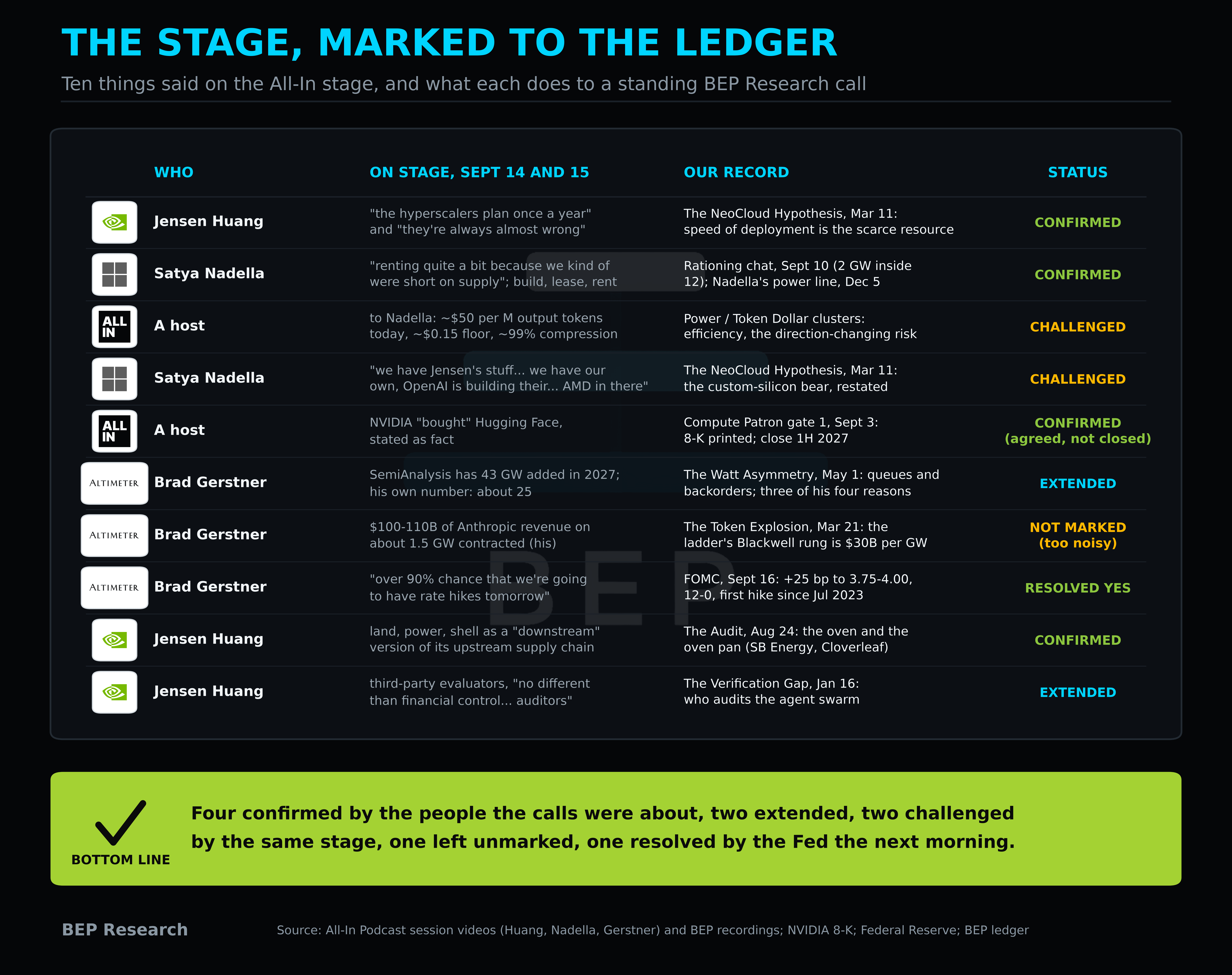
Jensen Huang told the room on Monday that the neoclouds’ first customers were the hyperscalers, and Satya Nadella, the same day, said Microsoft is renting capacity because it is short on supply. Both sessions are on the All-In Podcast’s channel, and the quotes here are checked against the published video. Both land on a call we made in March.
Jensen, on why the neoclouds exist: “all the early customers were the hyperscalers. And the reason for that is because the hyperscalers plan once a year. But the market dynamics is so volatile right now that they’re always almost wrong.” The regional clouds, he said, are now “a large scale distributed network of companies that are building, securing land, power, shell for us,” and he framed NVIDIA’s own power and site investments as a “downstream” version of its upstream supply-chain work.
As we wrote in The NeoCloud Hypothesis: “in a supply-constrained environment, speed of deployment is the scarce resource.” Our mechanism in March was hyperscalers diluting their deployment speed with their own silicon. Jensen’s is simpler: the big buyers plan annually, the market moves faster, and whoever can move a shell and a substation inside a quarter gets the first racks.
Nadella, on Microsoft’s own capacity: “right now we’re even renting quite a bit because we kind of were short on supply. But the overall goal is to build more, lease some and then if really need to surge we will even rent.”
Four days earlier, in the subscriber chat, we wrote up Bloomberg’s Microsoft road map as rationing at two gigawatts, about 2 gigawatts of AI chips inside a 12 gigawatt estate. Build, lease, rent is that road map from the CEO’s side, and its 38 gigawatts by 2032 excludes what Microsoft rents from neoclouds.
Two lines from the same day cut against us. A host put the labs’ economics to Nadella as token compression, roughly $50 per million output tokens today against an estimated floor near $0.15, which is the algorithmic-efficiency short, the one risk our clusters mark as changing direction rather than slope. And Nadella, on whose silicon Azure runs: “we have Jensen’s stuff which is I think our primary thing, we have our own, OpenAI is building their” silicon, “AMD in there.” That is our March custom-silicon bear, restated by a hyperscaler CEO.
One of the hosts said, as fact, that NVIDIA bought Hugging Face. Agreed is the word: a definitive agreement on September 3 at about $12.93 billion, filed on an 8-K, with the close expected in the first half of 2027.
We published The Only Company That Can Afford Free that same morning on press reports, and wrote that we were “not resizing a position we have held publicly since 2016 on a press report.” The 8-K printed the same day, so that piece’s first gate is confirmed, and our ledger carried it as open until this note.
Gerstner Cut the Gigawatt Forecast, and the Room Clapped
Brad Gerstner’s keynote on Tuesday cut next year’s AI compute build from SemiAnalysis’s 43 gigawatts to about 25, and three of the four reasons on his slide have been in our power file since December. The All-In Podcast published the talk on September 17 as “Brad Gerstner: No AI Bubble, Semis Eat the Nasdaq & AI’s Take Off Problem,” and his words here are from that video. His slide, sourced to SemiAnalysis and Dylan Patel on the Dwarkesh Podcast, August 25, counts global installed AI compute: 19 gigawatts added this year, 7 of them to OpenAI and Anthropic, and 43 next year, 14 to the two labs. On stage he called that base the country’s. His own number: “I think the total amount we’re actually going to stand up is somewhere closer to 25 gigawatts,” half of it for Anthropic and OpenAI. His “Atoms and Energy Are Hard” slide gives the reasons: permitting and local opposition, grid interconnection delays, skilled labor shortages, power equipment sold out.
We wrote this in the subscriber chat on Tuesday, the morning of the keynote: Gave us like 30 slides on the current state of AI investing, too numerous to summarize, just two things stood out: He’s predicting “only” 25 GW of new data center capacity coming online next year, half being used by Anthropic and OpenAI, as opposed to Dylan Patel’s 43 GW prediction. If the 10 year govt bond goes to 5.5% it’s a problem for massive capital investment (debt will dry up).
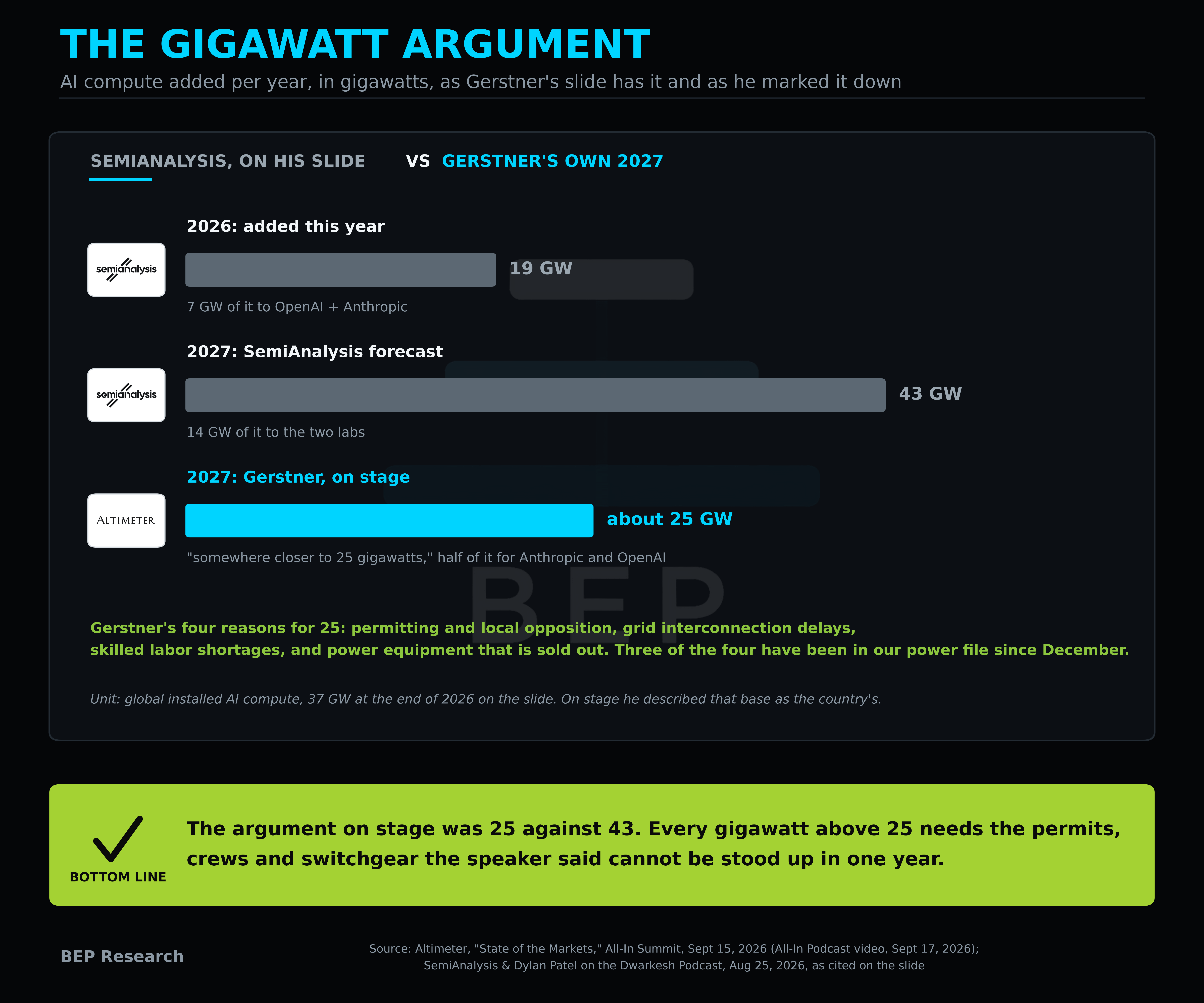
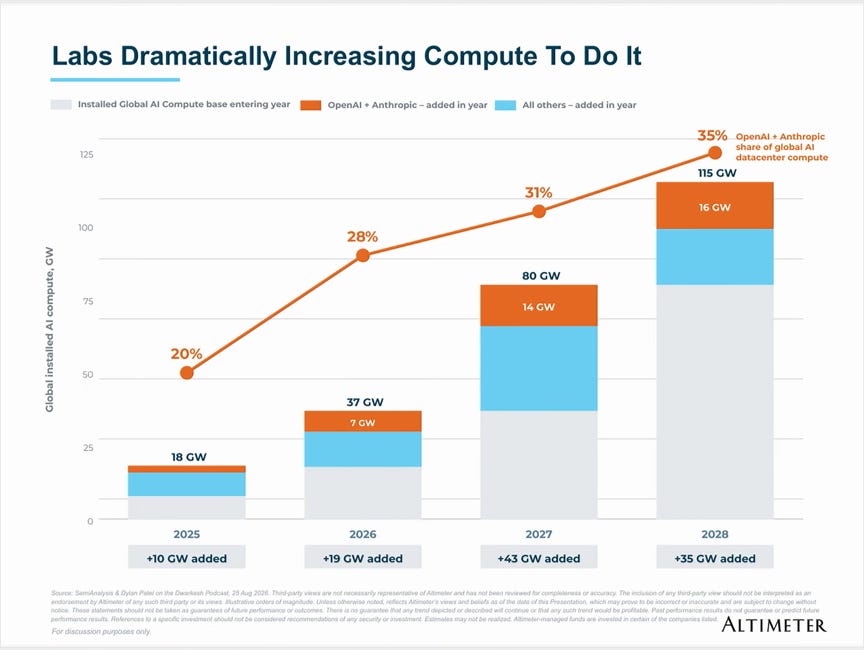
This is the mechanical constraint we laid out in The Watt Asymmetry in May: “The grid will not save the hyperscalers.” Interconnect queues and transformer backorders were that piece’s Layer 6, permitting and local opposition goes back to our December Bloom piece, and skilled labor is the box we never filed.
When Gerstner compared the treatment of data centers to nuclear plants, the room applauded. You could feel the agreement. That tells us something about the room’s conviction; it does not tell us whether the next county will approve a project.
The number he is watching is monthly lab revenue: “If the monthly AI lab revenues are closer to that $8 billion number, I think it’s takeoff.” He put the top three labs, Anthropic, OpenAI and SpaceX, at about a $100 billion collective run rate coming out of July, needing “at least $180 billion by the end of the year... just to keep the AI trade intact.” The IPO that traded down the day before on worry about a halt is Anthropic’s, and he does not expect one.
The nine minutes our recording missed were the valuation case: “This is no bubble like it was in 2000,” with Nvidia at 14 times next year’s fully taxed GAAP earnings, and semiconductors at 70% of the Nasdaq’s return. “The makers of the tokens are making the money and the buyers of the tokens are basically going along for the ride.” The slide for our Token Dollar cluster is “What has to be true? 2027 and Beyond”: hyperscaler capex of $788 billion this year and $1,086 billion next against lab AI revenue of $105 billion and $300 billion, his estimates. That gap is the carry question, drawn by a bull.
His third risk was rates. His “over 90%” on a hike the next day sat beside a slide showing about 88% market-implied odds, and the Federal Reserve delivered it the next morning, 25 basis points to 3.75 to 4.00 percent, with 16 of 18 participants expecting another this year. The ten-year answered by crossing 5 percent, 5.02 on Wednesday, and sat at 4.93 on Thursday. His level for trouble is five and a half on the ten-year, where the carry in the Token Dollar loop stops being a footnote.
Upgrade to read the full field report: six anonymized conversations, our table of the evidence that would test each claim, the polling and local-tax charts, the bear case, and how it all connects to our book. These are leads to investigate, with each source’s incentives made explicit. Paid subscribers can follow the open questions in our subscriber chat.
