


A lot of people are talking about Nvidia and Groq as if this were a TPU clone moment or a classic “buy the competitor” move.
It isn’t.
And if you look at Groq’s architecture closely, the deal actually looks confusing at first glance.
First, Let’s Be Precise About Groq
Groq is not a TPU clone. Not even close.
Google TPU uses an 8-wide VLIW for control with conventional compute units, a normal memory hierarchy with DRAM and caches, and familiar accelerator tradeoffs. It’s aggressive but architecturally recognizable.
Groq is something else entirely: 144-wide VLIW for everything, explicit scheduling across the entire program, no DRAM, no cache hierarchy, only on-chip SRAM, and deterministic execution or nothing runs at all.
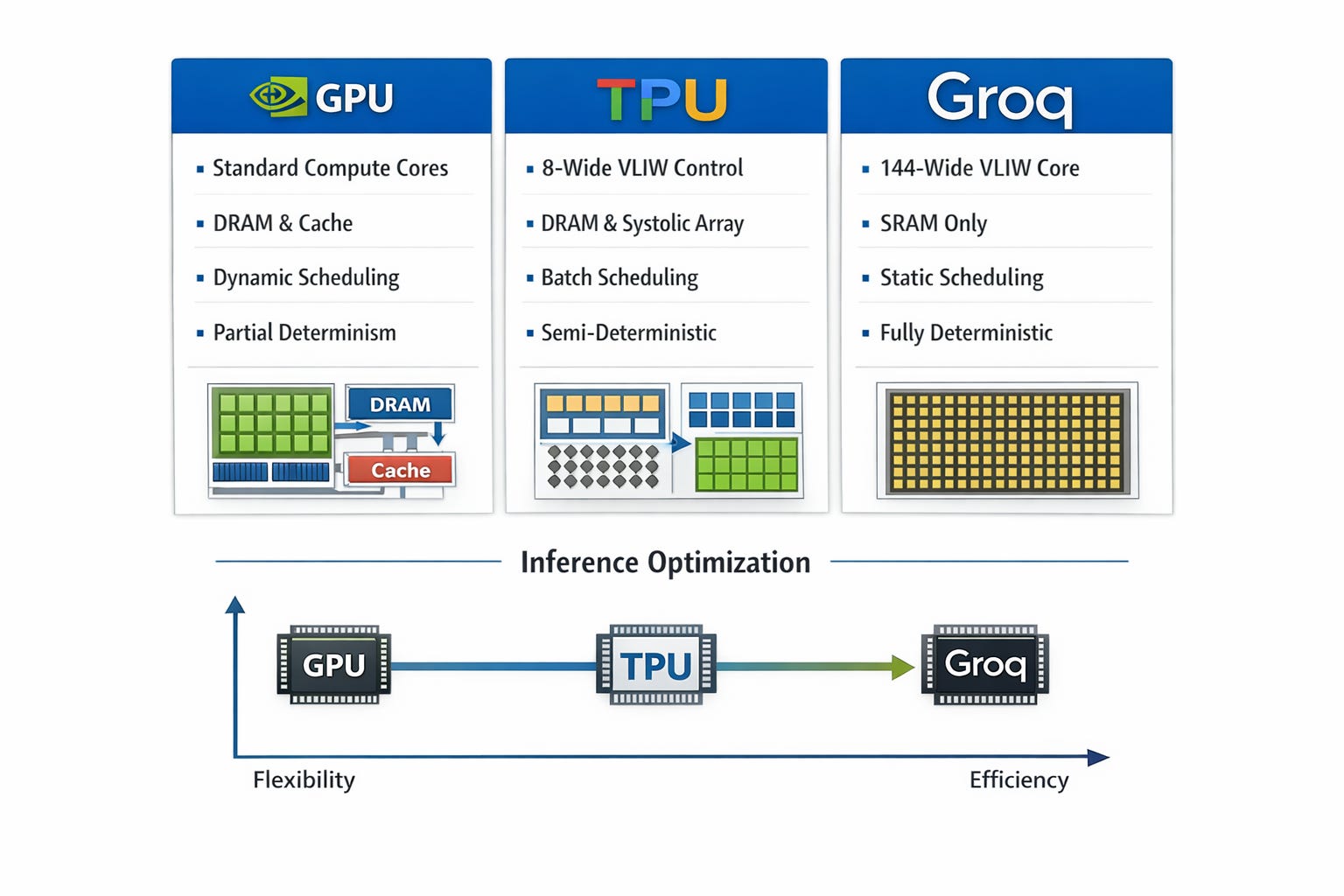
This is an extreme architecture. Brittle. Compiler-dominated. Hostile to real-world variability.
Having spent years working with silicon photonics in Professor Fainman’s lab at UC San Diego, I’ve seen what happens when you push systems to their deterministic limits—you get extraordinary performance in narrow conditions and catastrophic failure outside them. Groq is the chip-level embodiment of that tradeoff.
I really don’t like it as a general platform.
So why would Nvidia touch this?
This Was Not a Product Bet
If you think Nvidia licensed Groq because it wants to ship a Groq-like chip, that’s the wrong frame.
Nvidia did not buy Groq as a roadmap. They bought it as a boundary condition.
Groq answers a very specific question: What does inference look like if the graph is static, scheduling is solved offline, there is zero tolerance for nondeterminism, and memory stalls are eliminated entirely?
The answer is something ugly, fragile, and insanely fast.
That answer is valuable even if you never ship the architecture.
Why This Is Different from Enfabrica
Enfabrica made obvious sense. Networking. Fabric. Scale-out. Cleanly additive to Nvidia’s systems strategy.
Groq is not that.
This is not about productization. This is about learning the limits of inference efficiency.
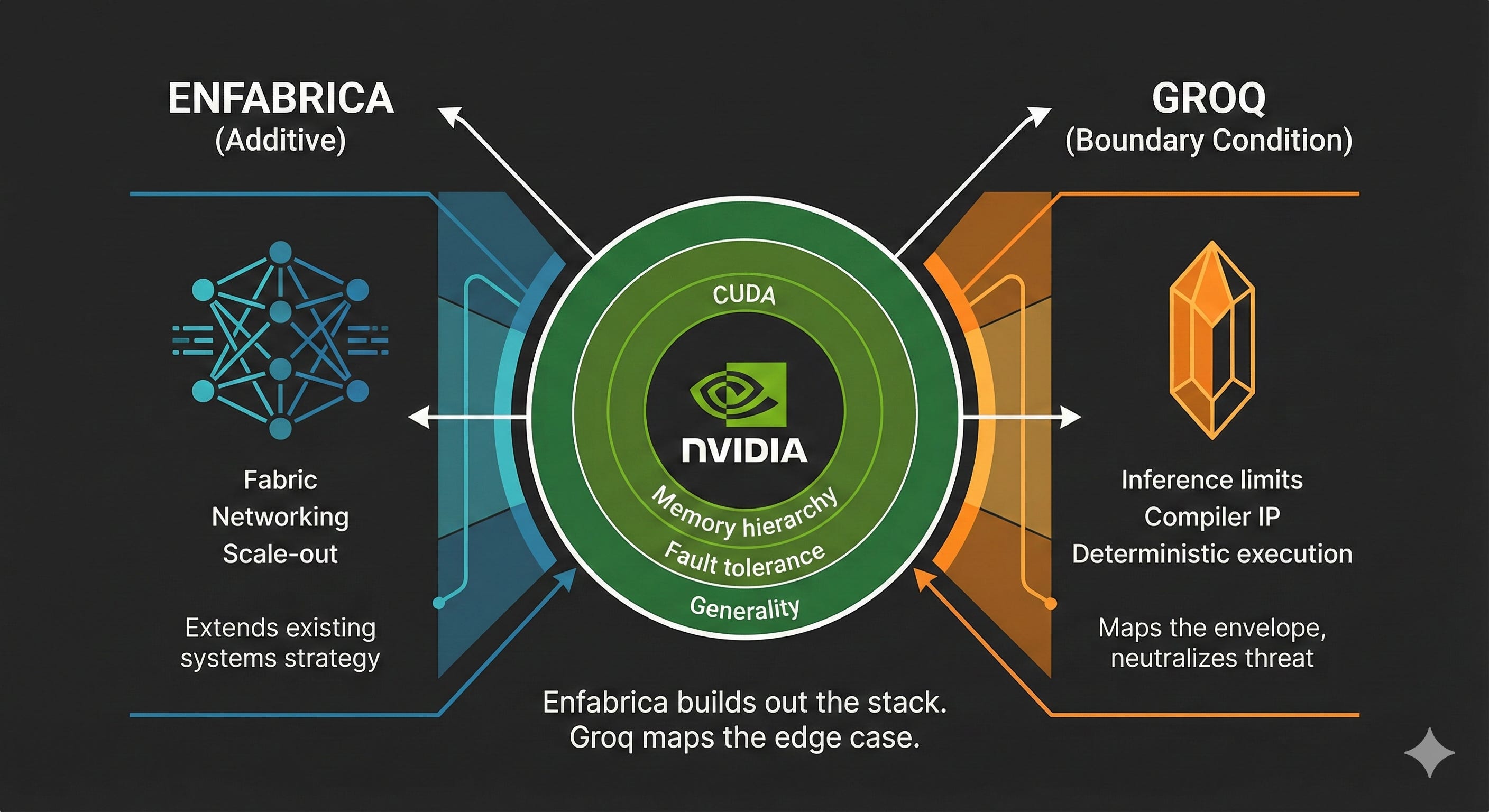
What Nvidia really gets: whole-graph scheduling techniques, deterministic execution models, compiler strategies for inference-first workloads, and a concrete upper bound on tokens per watt when you remove flexibility.
But here’s the hardware play that most people are missing: Groq’s architecture bypasses CoWoS and HBM entirely. No advanced packaging bottlenecks. No memory supply chain constraints. Just on-chip SRAM and deterministic execution.
That’s not a limitation—it’s a template.
Nvidia now has the IP to build a fast, inference-focused chip that sidesteps the two biggest capacity constraints in AI silicon: TSMC’s CoWoS packaging and the HBM supply chain dominated by SK Hynix and Samsung. Pair that with NVLink for chip-to-chip interconnect of LPU-style units, and you’ve got a scalable inference architecture that doesn’t compete for the same constrained resources as training GPUs.
Then Nvidia can reintroduce memory, CUDA, fault tolerance, and generality where needed—keeping the insights while discarding the insanity.
It’s the same approach we used at Deco Lighting when evaluating exotic LED driver topologies. You study the extreme to understand the envelope, then you build something practical that captures the lessons.
Why Licensing Instead of Acquisition Matters
This being a non-exclusive licensing deal is the tell.
Nvidia avoids antitrust friction, avoids committing to Groq’s architecture, pulls key technical talent in-house, and neutralizes Groq as a future bargaining chip.
Groq remains a company. The ideas do not remain independent.
That distinction matters.
The Uncomfortable Truth
This was never about competing with Google TPU.
This was about preventing Groq from becoming a hyperscaler-backed alternative, a pricing lever in inference negotiations, or a narrative wedge against CUDA dominance.
Groq in the wild is dangerous. Groq studied, licensed, and absorbed is not.
Bottom Line
Groq is weird. Groq is extreme. Groq is not a TPU clone. Groq is not a general solution.
Nvidia knows all of that.
They did not license Groq because they believe in it. They licensed it because they don’t want anyone else to weaponize it.
This wasn’t buying the future. It was buying the edge case.
And that is very Nvidia.
Resources
Disclaimer: This analysis is for informational purposes only and does not constitute investment advice. The author may hold positions in securities mentioned. Always conduct your own due diligence.
Ben Pouladian is CEO of BEP Holdings and publishes investment research on AI infrastructure and semiconductors. He previously co-founded Deco Lighting, scaling it to over $50M in revenue, and holds an electrical engineering background from UC San Diego where he studied silicon photonics in Professor Fainman’s ultrafast nanoscale optics lab.
Yeah, very interesting right before Christmas. In my opinion, it's to keep the moat strong. If you look at how they're shuffling around talent, it's not just a normal acquisition.
Interesting take on the Nvidia-Groq deal optimizing MoE inference via SRAM for shared experts. Ties perfectly into Nemotron Nano's efficient 3-3.6B active params for high-throughput agentic tasks, boosted by CuTile's portable kernels for hybrid hardware. Smart move for ecosystem dominance amid antitrust eyes.