

The Failure Mode Nobody Talks About
Imagine this scenario: A financial services firm deploys 500 AI agents to automate customer support, compliance checks, and document processing. The agents communicate with each other, share context, and escalate complex cases through automated workflows.
On day 47, an agent responsible for document classification encounters an edge case—a customer complaint formatted in an unusual way. It misclassifies the document and passes it to the wrong workflow. The receiving agent, trusting the classification, processes it incorrectly. That error propagates to three more agents. By the time a human notices, 2,000 customer records have been misfiled, 140 compliance deadlines have been missed, and the firm is facing regulatory penalties.
Post-mortem question: At what point could this have been caught?
The honest answer: nobody knows. There was no verification layer. No runtime audit. No systematic way to trace how the error cascaded. The agents were deployed because they worked in testing. Production revealed failure modes that testing never encountered.
This isn’t hypothetical. It’s the gap that sits beneath the entire “agentic AI” thesis—and almost nobody building AI infrastructure is working on it.
The Speed-Verification Paradox
Here’s where the co-design thesis meets its most uncomfortable implication.
The Semi Doped podcast identified “model routing and agent orchestration” as a key use case for hyper-low-latency inference like Groq’s LPU. When an AI system needs to decide which specialist model handles a query, the router itself can’t add meaningful latency. Sub-millisecond routing decisions are essential for responsive multi-agent systems.
But think about what that means for verification: the faster you make the routing decisions, the harder they are to audit.
If an agent orchestrator is making hundreds of routing decisions per second, and each decision can cascade into downstream actions, you’ve created a system that operates faster than any human can monitor and generates more decision traces than any logging system can usefully process.
We’re optimizing for speed on the inference side while leaving verification as an afterthought. That’s a structural mismatch that will eventually produce catastrophic failures.
The Observability Trilemma
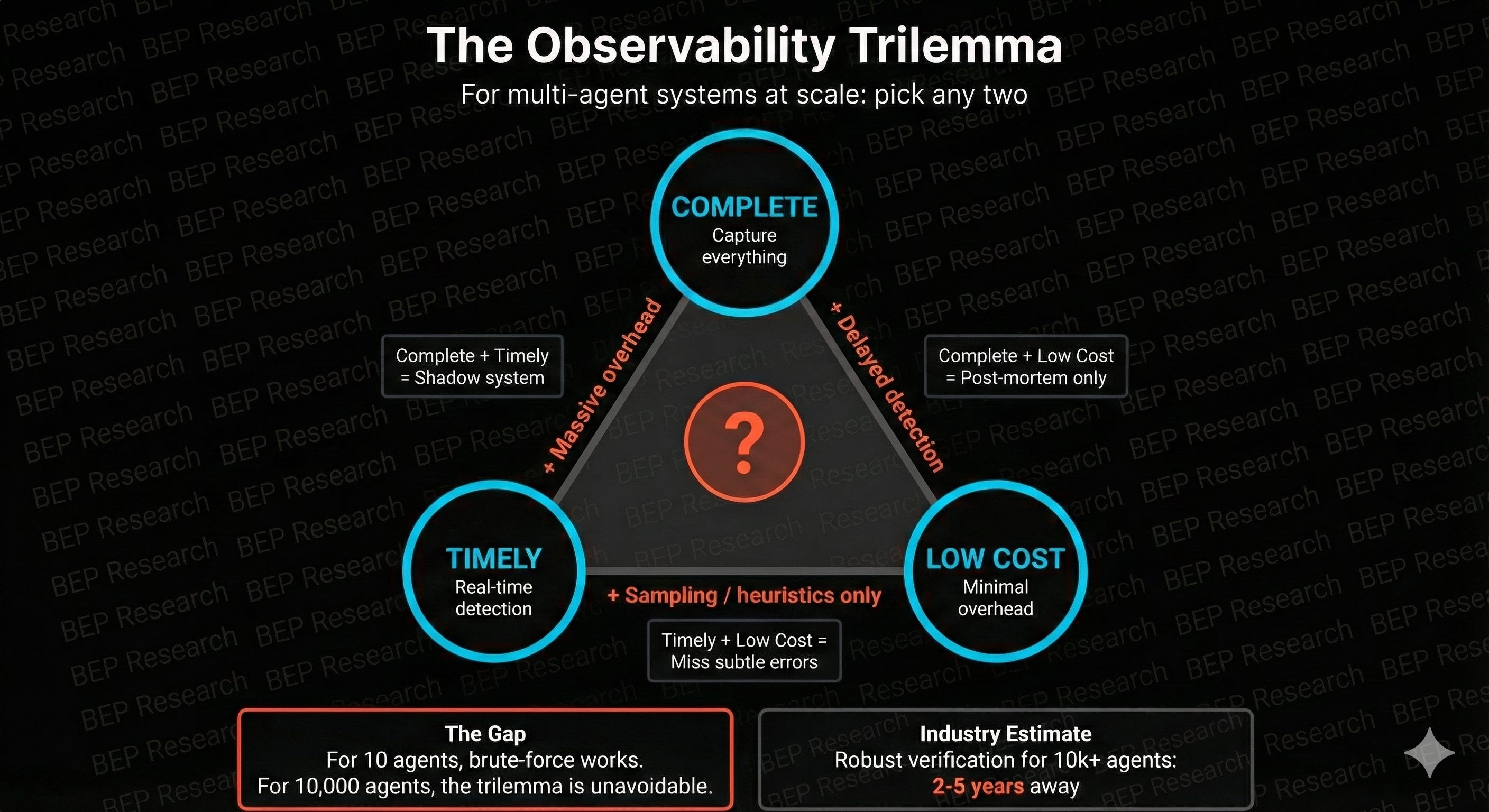
Every monitoring system faces a fundamental tradeoff. You can optimize for two of these three properties, but not all three:
Completeness: Capture every decision, every state change, every inter-agent communication. Miss nothing.
Timeliness: Detect anomalies in real-time. Catch errors before they propagate. Enable intervention.
Low Overhead: Don’t slow down the agents. Don’t consume more compute than the inference itself. Don’t become the bottleneck.
Pick any two:
Complete + Timely = Massive overhead. You’re essentially running a shadow system that monitors every operation.
Complete + Low Overhead = Delayed analysis. You log everything but process it asynchronously. Errors propagate before you detect them.
Timely + Low Overhead = Sampling and heuristics. You catch obvious failures fast but miss subtle cascading errors.
For 10 agents, you can brute-force completeness. For 10,000 agents, the trilemma bites hard.
Three Layers, Three Different Problems
The agentic AI stack has three distinct control challenges that often get conflated:
Layer 1: Orchestration
Problem: How do agents coordinate?
This is the most mature layer. Frameworks like LangGraph, AutoGen, CrewAI, and AWS Step Functions handle task routing, handoffs, and workflow sequencing. They answer: “Which agent handles this task next?”
Orchestration is largely solved for small-to-medium deployments. The frameworks exist. The patterns are established.
Layer 2: Verification
Problem: How do we know agents are doing the right thing?
This is the gap. Verification requires:
Pre-execution checks: Is this action appropriate given the context?
Runtime monitoring: Is the agent behaving as expected?
Post-execution audit: Did the action produce correct results?
Current approaches rely heavily on “LLM-as-Judge”—using another model to evaluate outputs. Research shows this is unreliable: simple adversarial triggers can inflate judge scores. You’re essentially asking a system with the same failure modes to verify itself.
OpenAI’s Swarm framework explicitly labels itself “experimental/educational” with “no built-in mechanism to coordinate large numbers of agents beyond handoffs.” That’s an honest acknowledgment: orchestration exists, but verification doesn’t.
Layer 3: Security
Problem: How do we prevent malicious exploitation?
Security concerns compound verification challenges. Research has demonstrated “infectious jailbreak” attacks where a single malicious input—an image, a document, a prompt—can compromise one agent and cascade through an entire system. The attack surface grows exponentially with agent count.
Security requires not just monitoring but active containment: sandboxing, permission scoping, and blast radius limitation. Most agentic deployments have none of this.
The Control Plane Checklist
What would it take to safely deploy 10,000+ agents? Here’s what must exist:
1. Deterministic Audit Trails
Every agent decision must be traceable. Every inter-agent communication must be logged. Every state change must be attributable. This is table stakes for any regulated industry.
2. Hierarchical Verification
Not every decision needs the same scrutiny. Low-stakes actions can be sampled. High-stakes actions require real-time verification. Critical actions require human-in-the-loop approval. The verification intensity must scale with consequence.
3. Cascade Detection
Errors that propagate across agents must be detected before they compound. This requires understanding the dependency graph—which agents pass outputs to which other agents—and monitoring for anomalies at the graph level, not just individual nodes.
4. Blast Radius Containment
When an agent fails or is compromised, the damage must be limited. Permission scoping, resource quotas, and automatic circuit breakers prevent single points of failure from becoming system-wide incidents.
5. Formal Verification for Critical Paths
Some workflows—financial transactions, medical decisions, safety-critical systems—require mathematical guarantees, not statistical confidence. Formal methods must be integrated into the agent pipeline.
6. Human Escalation Protocols
Agents must know when they’re out of their depth. Confidence thresholds, uncertainty quantification, and clear escalation paths to human operators are non-negotiable for production deployment.
Current state: Almost none of this exists at scale.
Companies like Arize AI, Langfuse, and LangSmith provide observability tools—logging, tracing, evaluation. But observability is not verification. Watching agents fail is not the same as preventing failure.
Based on the current state of tooling, I estimate the gap between current capabilities and robust verification for thousands of agents is 2-5 years. The compute is becoming available. The verification layer isn’t.
Investment Framework: Who Wins the Co-Design Era
Stepping back from verification to the broader co-design thesis: where should capital flow?
Here’s a simplified framework across six categories. This is a lens for analysis, not investment advice—do your own diligence.
Category 1: Vertical Integrators
Companies that control multiple stack layers and can co-design internally
NVIDIA — Training monopoly plus inference stack depth via acquisitions; Vera Rubin proves extreme co-design works; January 2026 TensorRT-LLM update delivered 2.8x throughput gains on existing hardware through software optimization alone
Google — TPU + JAX/XLA + Gemini end-to-end co-design
Amazon — Trainium/Inferentia + captive cloud workloads
Microsoft — Maia silicon + Azure + OpenAI partnership
Category 2: Foundry and Packaging
Essential manufacturing infrastructure everyone needs
TSMC — CoWoS advanced packaging, COUPE silicon photonics, process leadership
ASE Group — Advanced packaging assembly and test
Category 3: Memory and Bandwidth
The memory wall creates structural demand
SK Hynix — Dominant HBM supplier (estimated 50-60%+ share), NVIDIA lock-in
Samsung, Micron — HBM capacity expansion
Rambus — Memory interface IP, HBM controller designs
Category 4: Interconnect and Networking
As clusters scale, network becomes the bottleneck
Lumentum — Key supplier for NVIDIA CPO laser components
Coherent — Silicon photonics, vertical integration
Broadcom — Networking silicon, Tomahawk switches
Marvell — Custom silicon for hyperscalers
Credo, Astera Labs — Pure-play connectivity silicon
Category 5: Equipment and Materials
Enabling capacity expansion regardless of who wins
Applied Materials, Lam Research — HBM packaging equipment
KLA — Process control and metrology
ASML — Lithography (though increasingly priced in)
Category 6: At Risk
Facing structural headwinds from vertical integration
Innolight, traditional transceiver suppliers — NVIDIA CPO in-sourcing risk
Intel — AI accelerator strategy in flux, playing catch-up
Pure-play inference startups without differentiated architecture — Commoditization as hyperscalers build internally
Wild Card: Unconventional AI’s Radical Bet
If co-design is the future, Naveen Rao is betting on its most extreme form.
Rao sold Nervana to Intel (~$400M, 2016) and MosaicML to Databricks ($1.3B, 2023). His new venture, Unconventional AI, emerged in December 2025 with a reported $475 million seed round at a reported $4.5 billion valuation, according to The Register—backed by Andreessen Horowitz, Lightspeed, Sequoia, and Jeff Bezos.
The thesis: we’re forcing probabilistic intelligence through deterministic hardware. The brain runs on 20 watts. GPUs burn over a kilowatt. Rao argues current approaches are orders of magnitude less efficient than the theoretical Landauer limit—he’s cited figures as dramatic as 10 billion times.
Rather than simulating neural dynamics on digital logic, Unconventional plans to build circuits that leverage the intrinsic physics of silicon to perform learning directly. As Rao has described it publicly:
“Intelligence is about systems; and each element in biological systems has complex, non-linear dynamics. Why should our synthetic versions be any different?”
He calls this “extreme co-design”—not just hardware and software together, but the fundamental physics of computation reimagined.
Whether Unconventional succeeds or not, Rao has framed the question clearly: the transformer-on-GPU era may be dominant, but it is not inevitable.
The Takeaway
Three threads run through this series:
1. The memory wall is reshaping architectures. Groq’s SRAM approach and Jamba’s SSM-hybrid design are early responses. More will follow. Bandwidth, not compute, sets the inference ceiling.
2. NVIDIA is buying stack depth, not market share. The Israel acquisitions fill specific layers—networking, orchestration, optimization, model IP. Vera Rubin proves the goal: inference ecosystem lock-in through extreme co-design. The 2.8x throughput gain from software alone shows stack depth compounds over time.
3. The verification gap is the unsolved problem. We’re building infrastructure to deploy millions of agents without infrastructure to verify they’re working correctly. The compute is ready. The control plane isn’t.
The winners of the co-design era will be those who recognize that hardware, software, and—increasingly—verification infrastructure must be designed as unified systems. The boundaries are dissolving. The question is who builds the new integrated stacks.
The great unbundling of the cloud era is giving way to the great re-bundling of AI infrastructure. The competition to own that bundle has only begun.
If you found this analysis valuable, please share it—it helps more than you know. And if you haven’t subscribed yet, now’s the time. BEP Research will be moving to paid soon, and early subscribers will be grandfathered in. I’m committed to delivering institutional-quality analysis on AI infrastructure that you won’t find anywhere else.
Resources
NVIDIA CES 2026: Six Chips, One Platform, and the Extreme Codesign Era (BEP Research)
Twas the Night Before Groq: NVIDIA’s Surprise Licensing Deal (BEP Research)
Delivering Massive Performance Leaps for MoE Inference on NVIDIA Blackwell (NVIDIA Developer Blog)
9 Key Challenges in Monitoring Multi-Agent Systems at Scale (Galileo AI)
Bezos-backed Unconventional AI Addresses Datacenter Power (The Register)
About the Author
Ben Pouladian is a Los Angeles-based tech investor and entrepreneur focused on AI infrastructure, semiconductors, and the power systems enabling the next generation of compute. He was co-founder of Deco Lighting (2005–2019), where he helped build one of the leading commercial LED lighting manufacturers in North America. Ben holds an electrical engineering degree from UC San Diego, where he worked in Professor Fainman’s ultrafast nanoscale optics lab on silicon photonics and micro-ring resonators, and interned at Cymer, the company that manufactures the EUV light sources for ASML’s lithography systems.
He currently serves as Chairman of the Leadership Board at Terasaki Institute for Biomedical Innovation and is a YPO member. His investment research focuses on AI datacenter infrastructure, GPU computing, and the semiconductor supply chain. Long-term NVIDIA investor since 2016.
Follow on Twitter/X: @benitoz | More at benpouladian.com
Disclosure: The author holds positions in NVIDIA and related semiconductor investments. This is not investment advice.
Hi Ben, this is a wonderful piece, and I thoroughly enjoyed reading it. I do have a question about the investment thesis around agent orchestration—a theme that’s been coming up more frequently, especially in the recent earnings calls from Intel and AMD regarding strong demand for server CPUs. While I’ve seen some commentary suggesting that CPU demand won’t mirror that of memory, since CPUs don’t directly improve model performance, I’m curious to hear your take on the role of CPUs in the future of agentic workflows. Thanks!
An interesting take. If you think about AI agents as the equivalent of employees on a network, we’re basically going to increase the population by 10x without much training. Sort of like ICE. One area (I hope and believe) will serve as a template is industrial. Controlling, managing, and extracting value from machine data is an art. I wrote case studies on a wastewater utility that could predict sewer blowouts 12 hours in advance. Then there were people who couldn’t figure out why trucks were blowing up for years. It’s a test environment for the rest of us.