

Our primer on AI drug discovery put Iambic Therapeutics in the private cohort you couldn’t buy. As of this week you can. Iambic priced its IPO on October 14 at $16.00, the middle of its range, sold 9,375,000 shares for $150 million and listed on Nasdaq as IAM. It closed its first day at $18.91, up 18.2%.
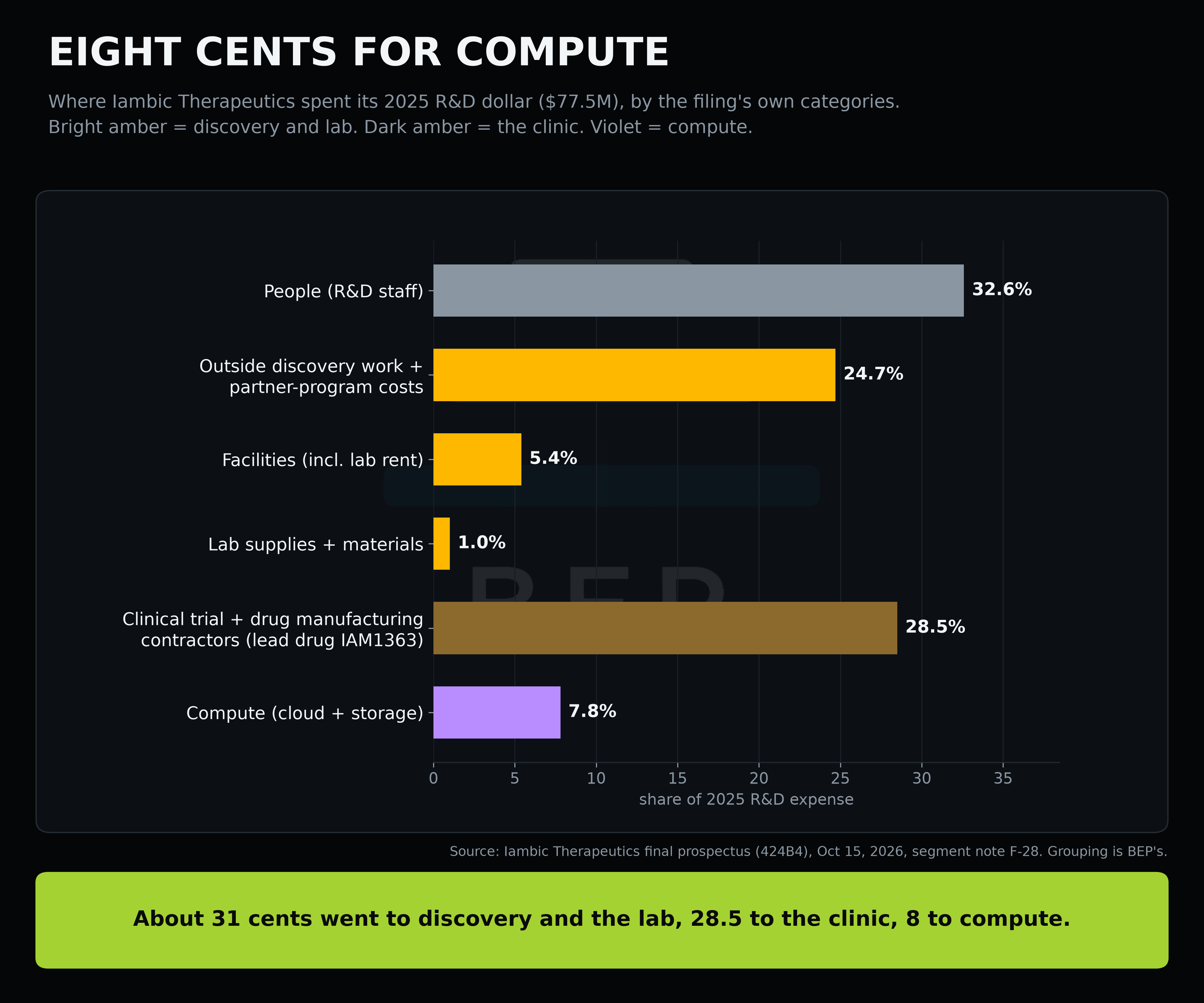
NVIDIA owns about 3.9% of Iambic by our count from the prospectus, and Lambda’s GPU cloud trained its Enchant model. You’d expect a compute story from that profile. The segment note in its final prospectus tells a different one. Of the $77.5 million Iambic spent on R&D in 2025, about 8 cents of each dollar went to cloud compute and storage. About 31 cents went to discovery and the lab: outside discovery work, lab rent and lab supplies. About 28.5 cents went to the clinic, the contract trials and drug manufacturing for its lead drug. People took the rest, about a third.
Compute is growing fast, from $2.2 million in 2024 to $6.0 million in 2025 and $4.4 million in the first half of this year. Call it 8 cents today. It’s still a small bill next to the lab and the clinic, and that was the argument we made on August 10 when we launched the AI-Science Basket.
The Basket Is Up 20.5% While Biotech Fell
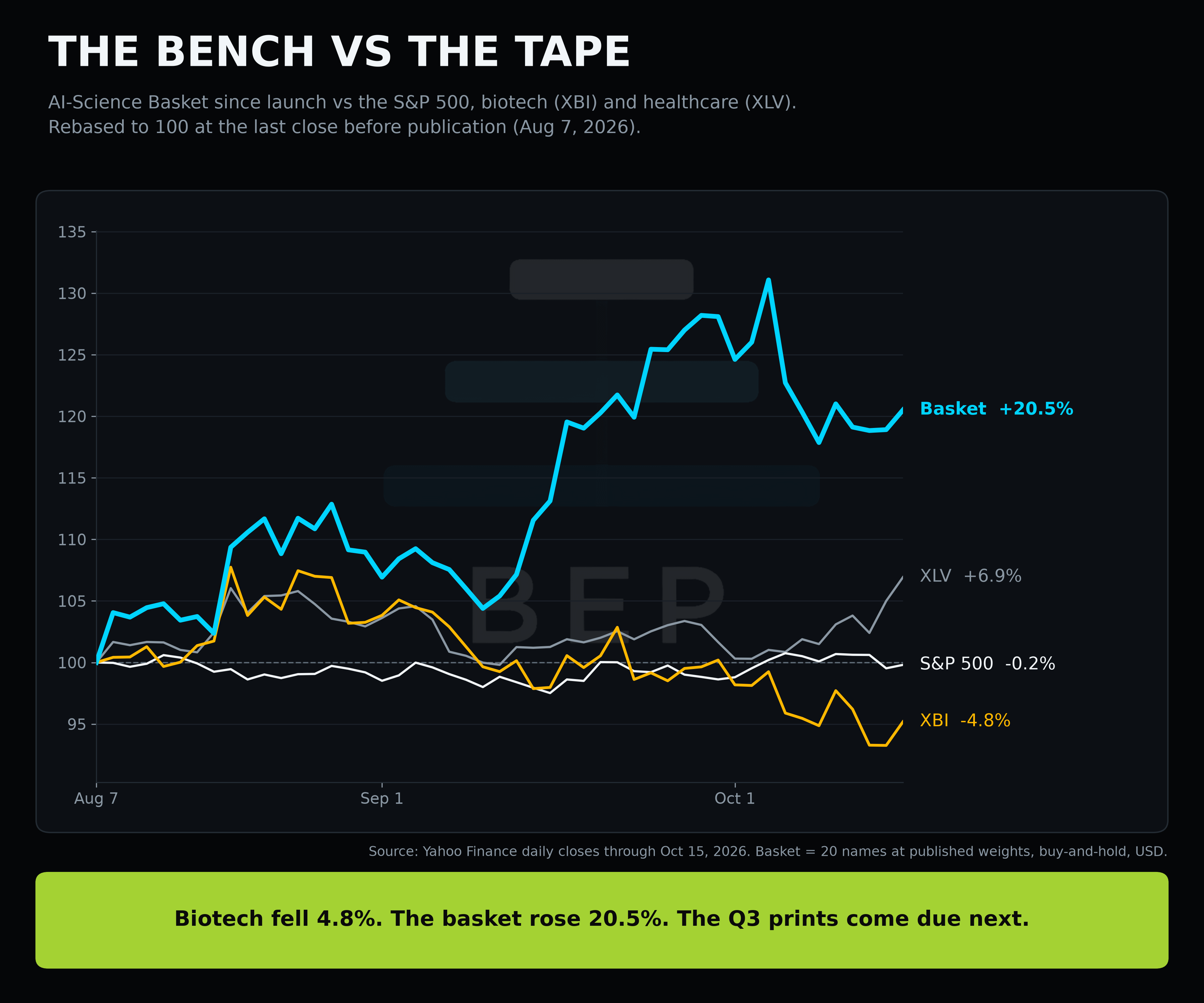
From the August 7 close, the last one before we published, to the October 15 close, the published book of the AI-Science Basket rose 20.5%. The S&P 500 fell 0.2%. Biotech, measured by XBI, the benchmark we picked at launch, fell 4.8%, and healthcare (XLV) rose 6.9%. Nineteen of the 20 names are up; only NVIDIA fell, by 3.0%. The live version runs on the tracker. (Counted from the August 10 close, as our August 21 chat did, it’s up 15.8%.)
The basket peaked at +31.1% on October 5, then fell 6.4% the next day, its worst session, while the S&P 500 rose. We found no news behind it. The book is about 8% below that peak. Rates didn’t carry it either. The Fed raised its target range a quarter point on September 16, its first hike since July 2023.
I own the basket as published, except that I trimmed Twist in my own account on October 5. Full disclosure is at the end.
Which leaves the question to ask of any 20% move in ten weeks: did the businesses earn it, or did the multiples just stretch? Hold that thought.
The Market Split the Bench Into Data and Manufacturing
As we put it on August 10 in The Next Inflection Is the Lab: “The tools layer isn’t one exposure. It’s two, running on different clocks.” Instruments were the deferrable capex clock; consumables were the activity clock, paid per experiment.
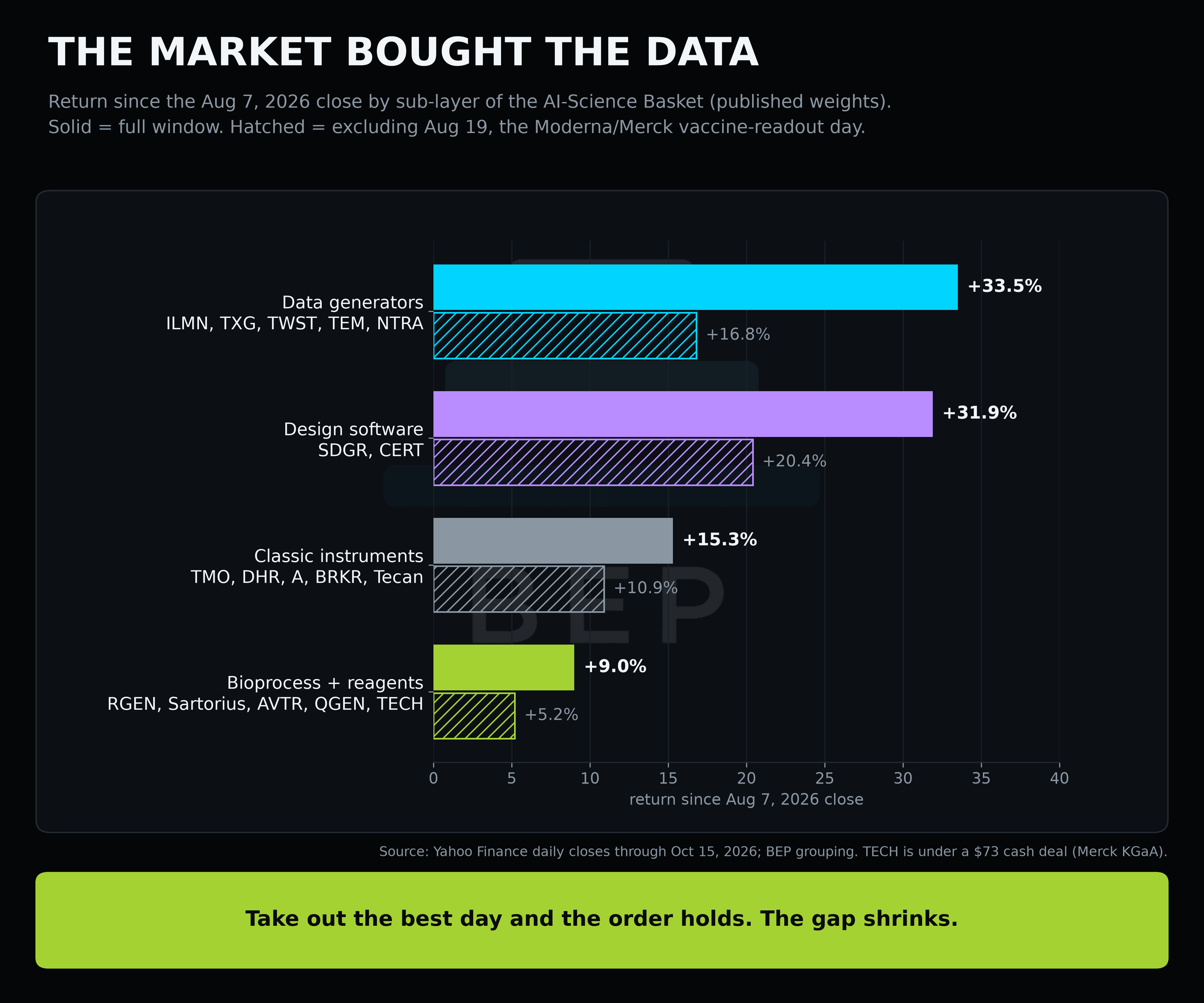
The market split it another way, by what the companies sell. The ones that turn experiments into data, Illumina, 10x Genomics, Twist, Tempus and Natera, rose 33.5% as a group. Design software, Schrödinger and Certara, rose 31.9%. The classic instrument makers, Thermo Fisher, Danaher, Agilent, Bruker and Tecan, rose 15.3%. Bioprocess and reagents, Repligen, Sartorius, Avantor, QIAGEN and Bio-Techne, rose 9.0%, or 11.5% without Bio-Techne, whose price is pinned by a cash takeover.
That last group is where our framing breaks. Bioprocess consumables are paid per use too. But they get used up making biologic drugs at scale, so they ride manufacturing volume, and manufacturing volume wasn’t what the market wanted this quarter. We’d sorted the bench by how customers pay for it. The tape sorted it by what the work produces, and the line that mattered ran between discovery and manufacturing.
It’s also the claim the launch piece rested on, that the scarce input to a great biology model isn’t compute but measured data at scale. We call it The Market Bought the Data.
People are hungry for data. There’s data brokers and a lot of these biotech companies have a lot of data. And then obviously Terray, which I’m an investor in, has a lot of chemistry and molecule data. That’s where it is.
Management teams said it too. At a Baird conference on September 15, Twist CEO Emily Leproust described what her AI customers ask for: “Some customers are saying, actually, I don’t want the protein. I just want the data.” Waters, which isn’t in the basket, said in its October 13 AI Link release that AI generates hypotheses faster than labs can test them, so the bottleneck has moved from computation to the bench.
One day did a lot of this work. The basket’s best day, August 19 (+6.8%), came when Moderna and Merck’s individualized mRNA cancer therapy, given with Keytruda, met its Phase 3 endpoint in melanoma. Each patient’s tumor has to be sequenced to build that drug, so Tempus rose 24%, Twist 23% and Illumina 9%. That was demand for measurement from a drug that worked, and none of it came from AI, so we ran the numbers without it. Take out August 19 and the data makers are up 16.8%, design software 20.4%, the classic instruments 10.9% and bioprocess 5.2%. The basket is still up 12.7% while XBI is down 10.1%. The order holds, and the gap between the data makers and the instruments shrinks from about 18 points to about 6. Without that day, Twist is up 1.9%, Tempus 10.1%, Illumina 30.9% and 10x 24.5%.
I think it’s like this Jevons paradox of medicine. As compute gets stronger, the cost of finding things in medicines gets cheaper. So it allows people to sequence the data of the people and all this other stuff. And then you’re able to bring the cost down and have personalized medicine for everyone.
Two more drivers had nothing to do with AI. Illumina joined the S&P 500 on September 21 (announced September 4), and index buying is part of its 42.5%. And our instrument names moved about as much as tools makers outside the basket, around 15%. That part was sector beta.
Iambic Plans More Experiments, and Cheaper Ones
Read past the cost split and the S-1 describes a company built around its own wet lab. It runs “automated plate-based chemistry and biology workflows that allow synthesis and testing of hundreds of compounds per program on a weekly cadence.” It has eight discovery programs, its own and partnered, and expects “as many as 25 supported programs in 2027.” It signed a lease for “approximately 95,985 square feet of office and laboratory space,” against “approximately 12,545 square feet” today.
The prospectus names Anthropic and OpenAI as competitive pressure, then comes close to our thesis in its own words: “we believe successful therapeutic development requires more than access to general-purpose AI models. Drug discovery depends on the integration of proprietary experimental data, specialized biological and chemical expertise, automated laboratory infrastructure, translational science, and clinical development capabilities.”
The money tells a narrower story. The lines we can tie directly to the basket’s products were small in 2025: $0.8 million of lab supplies and $1.3 million of equipment purchases, against $6.0 million of compute. Most of the outside discovery dollar goes to contract research firms, and Iambic names WuXi AppTec as one. Those firms buy from the bench. The basket owns that bench and none of the contractors.
The complication sits in the same document. The risk factors describe an approach built to “predict their key properties without conducting time-consuming and expensive physical experiments.” The business section says, “The platform is designed to scale without needing proportional increases in headcount, lab space, or custom assay development.”
Put the two halves together and Iambic plans to run more experiments that each cost less. Cheap lab assays stand in for some animal work. That’s good for high-throughput consumables, lab automation, sequencing and DNA writing.
It also cuts against something we said. On August 10 we called the structural instruments, NMR and cryo-EM, the moat, and Bruker “the purest expression of the thesis.”
Iambic designed one drug candidate “without access to a high-resolution co-crystal structure,” letting its models supply the structure instead. The filing never mentions NMR or cryo-EM; carrying the point over to them is our inference. Bruker’s own numbers haven’t turned yet. Its scientific-instrument organic bookings rose 10% in the second quarter with book-to-bill above 1, the metric we named in August as the test for the instrument half, and the stock barely re-rated, at about 23 times earnings.
Iambic priced at the low end of its public peers, and below its last private round of $17.14 a share this spring. At the first-day close it was worth about $896 million, or about $487 million net of $409 million of pro forma cash as of June 30, by our arithmetic. Recursion, Absci, Schrödinger and Generate Biomedicines carry enterprise values of roughly $1.2 billion to $1.7 billion. Iambic’s lead drug, a HER2 cancer pill, is in Phase 1/1b. I don’t own it.
So here’s what we’ll dig into:
Who did the lifting, and why was it the drug bet we sized small?
Was a 20% rally in two months earnings, or just multiples?
Which three names actually earned their move?
If you could own only five of the 20, which five?
Why did I trim Twist the day before it peaked?
What’s the real bear case, and does Anthropic’s own paper make it worse?
What three tests would prove us wrong by May 2027?
What would get Iambic into the book, and when?
Let’s get into it...
