


Why Oracle’s Q4 call may be the canary in the data center coal mine
Introduction
Something big is happening under the surface of AI’s rise, and it’s not just about model size or GPU specs.
It is about supply and demand. Not in theory, but in the most basic and brutal economic sense. There is not enough compute infrastructure to meet the needs of AI companies, enterprises, or governments. And the market is beginning to feel it.
Oracle’s Q4 earnings call gave us the clearest signal yet.
“We’ll take everything you have”
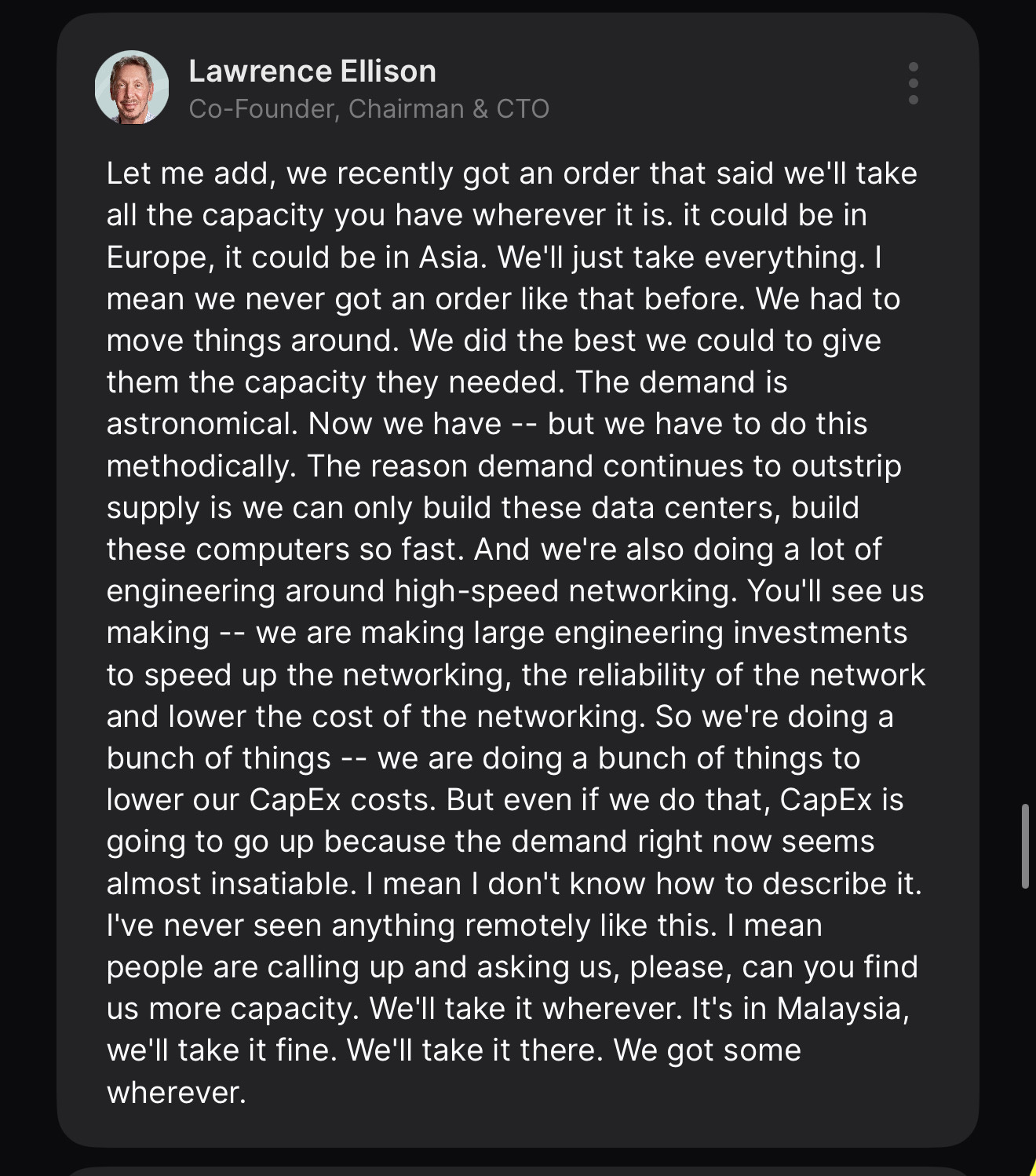
Larry Ellison said a customer approached Oracle and asked to buy all of its available AI compute capacity. Not in one location. Not for a specific project. They asked for every unit of infrastructure Oracle had, whether it was in Europe, Asia, or elsewhere.
That moment was not just a throwaway anecdote. It was a flashing red light.
Ellison went on to describe AI infrastructure demand as “almost insatiable.” He said Oracle had never seen anything like it. That includes the cloud boom, the rise of SaaS, and the early internet wave. Nothing compares to what they are seeing now.
CapEx is going up. New data centers are being deployed. High speed networking is being scaled. And still it is not enough.
This is not cloud. This is something new
Cloud computing taught enterprises how to think about renting compute instead of building it. AI is teaching them something more urgent. If you do not secure compute now, you may be left behind entirely.
AI models are voracious. Training them takes thousands of GPUs. Running them in production takes even more. Companies that waited during the cloud shift could still catch up. This is different.
The market is moving faster than infrastructure can be built. That is not a temporary supply chain issue. It is a structural choke point.
Nvidia builds the chips but delivery is now the constraint
Nvidia is the backbone of this revolution. No doubt. But the constraint has shifted. It is no longer just about getting your hands on an H100. It is about whether that chip is installed, cooled, networked, and tied into a usable platform. That is where companies like Oracle come in.
Microsoft, Amazon, Google, and Oracle are all in a race to turn silicon into service. Whoever can do that fastest — with reliability, scale, and enterprise-grade security — is going to win the next phase of AI.
This is not about having the best model. It is about having access to the runway. Without infrastructure, even the best algorithm is just theory.
A global land grab for usable compute
When customers are willing to take capacity in any geography, that tells you everything about urgency. This is not a feature or pricing decision. This is a survival move. Companies are doing whatever it takes to lock in infrastructure before it gets even tighter.
What used to be a market led by innovation is now being shaped by constraint. It is a gold rush and the pickaxe is compute.
Why this matters more than the models themselves
The next OpenAI or Anthropic may not die because of competition. It may stall because it cannot access the infrastructure it needs to train or deploy at scale. We are entering an era where success will be dictated not only by talent or capital but by logistical access.
If infrastructure is the new bottleneck, then providers like Oracle may have more upside than anyone realizes. They are not just hosting the future. They are rationing it.
Closing Thought
AI is not slowing down. But infrastructure is. And that makes this one of the most important market shifts we have seen in tech since the rise of the public cloud.
The companies that own the pipes, power, and platforms are about to shape the next decade. Oracle just pulled back the curtain.
This is the beginning of the AI infrastructure wars.
Why this matters more than the models themselves
The next OpenAI or Anthropic may not die because of competition. It may stall because it cannot access the infrastructure it needs to train or deploy at scale. We are entering an era where success will be dictated not only by talent or capital but by logistical access.
If infrastructure is the new bottleneck, then providers like Oracle may have more upside than anyone realizes. They are not just hosting the future. They are rationing it.