


Mahesh Thiagarajan, EVP of Oracle Cloud Infrastructure, in today’s release: “Together, Bloom and Oracle Cloud Infrastructure are building the power foundation and AI infrastructure to accelerate American AI leadership.”
That is a hyperscaler executive describing a fuel cell vendor as foundational infrastructure. Not auxiliary. Not a hedge against grid delays. The power foundation. Read that line twice. It tells you exactly how Oracle now categorizes Bloom internally, and it is not the category Wall Street has been pricing.
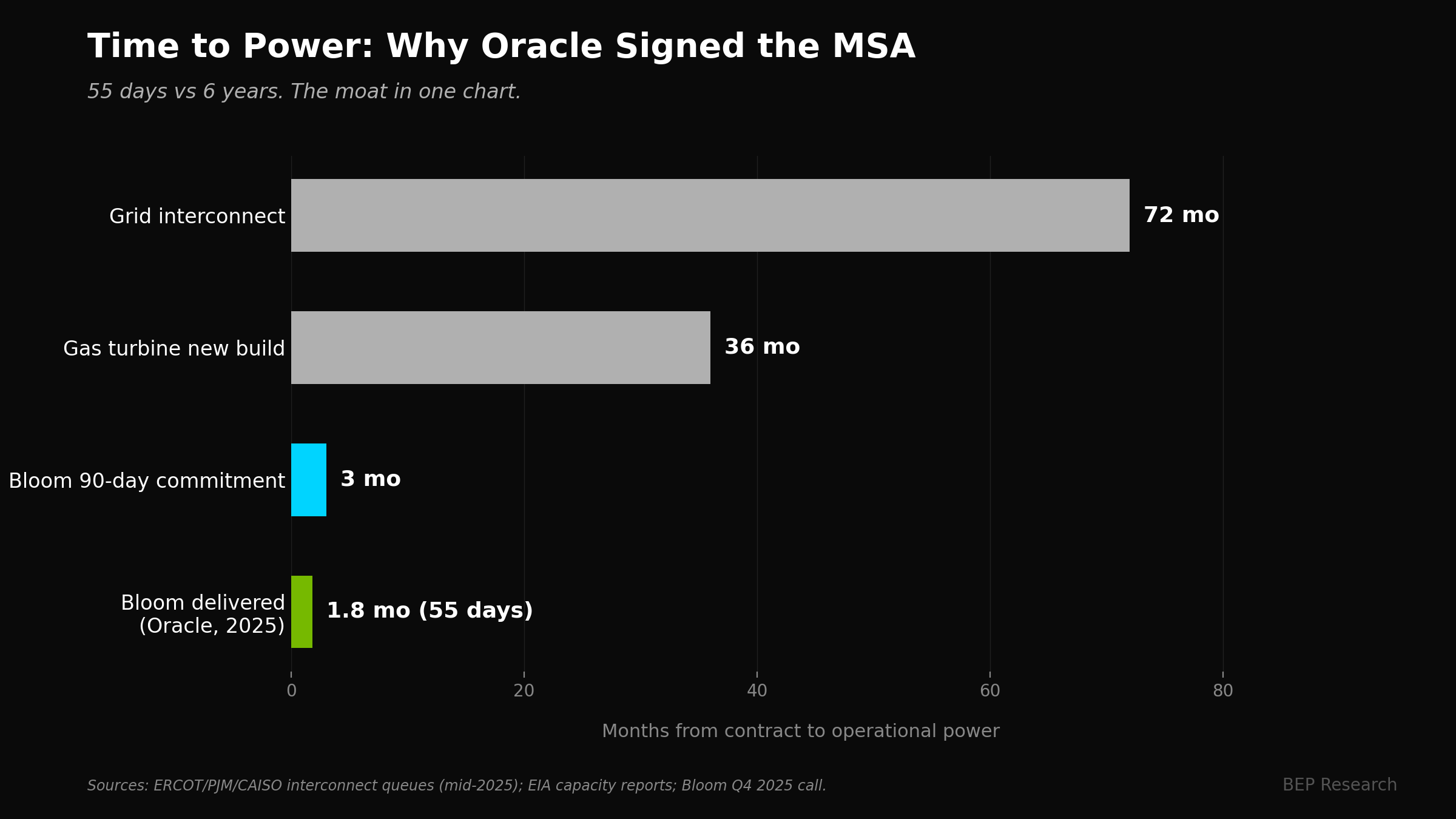
This afternoon Bloom and Oracle announced a master services agreement covering up to 2.8 GW of fuel cell capacity, with 1.2 GW already contracted and deploying through next year. Two business days earlier, on April 9, Bloom issued the warrant to Oracle on the terms originally announced October 30, 2025.
The headline writers will lead with 2.8 GW. The actual story is structural, and I called the catalyst in February.
The Watch List Item That Just Resolved
In my Q4 update on February 7, I closed the piece with a list of things I was watching next. One of them was this:
As I wrote in “Bloom Energy Q4 Update: The Backlog”: “Oracle warrant details. K.R. confirmed the strategic partnership agreement hasn’t been finalized yet, but said details are forthcoming. The warrants were struck at market prices, not penny warrants. The commercial relationship is active ‘across many projects.’”
Today is when “forthcoming” became “executed.” The MSA is the formalization. The April 9 warrant issuance is the economic lock. The 1.2 GW initial contracted volume is the proof that the master agreement is not a press release with a number bolted on. It is a procurement vehicle Oracle is already drawing against.
What changed from a project-by-project supply relationship to an MSA matters more than the gigawatt headline. Master services agreements eliminate per-deal negotiation friction. Oracle can call down capacity against a pre-negotiated commercial framework. Bloom can plan factory loading against a committed customer ceiling. Both sides have just told the other “we expect to do this many times.”
Bloom has run this playbook before in commercial and industrial. Two-thirds of C&I revenue is repeat customers under master contract structures. The MSA imports that repeat-order machinery into the AI data center segment with the largest single counterparty in the book.
1.2 GW Is the Number That Counts
I want to be precise about what Oracle actually committed to today, because the bear case will start at the gap between 1.2 and 2.8.
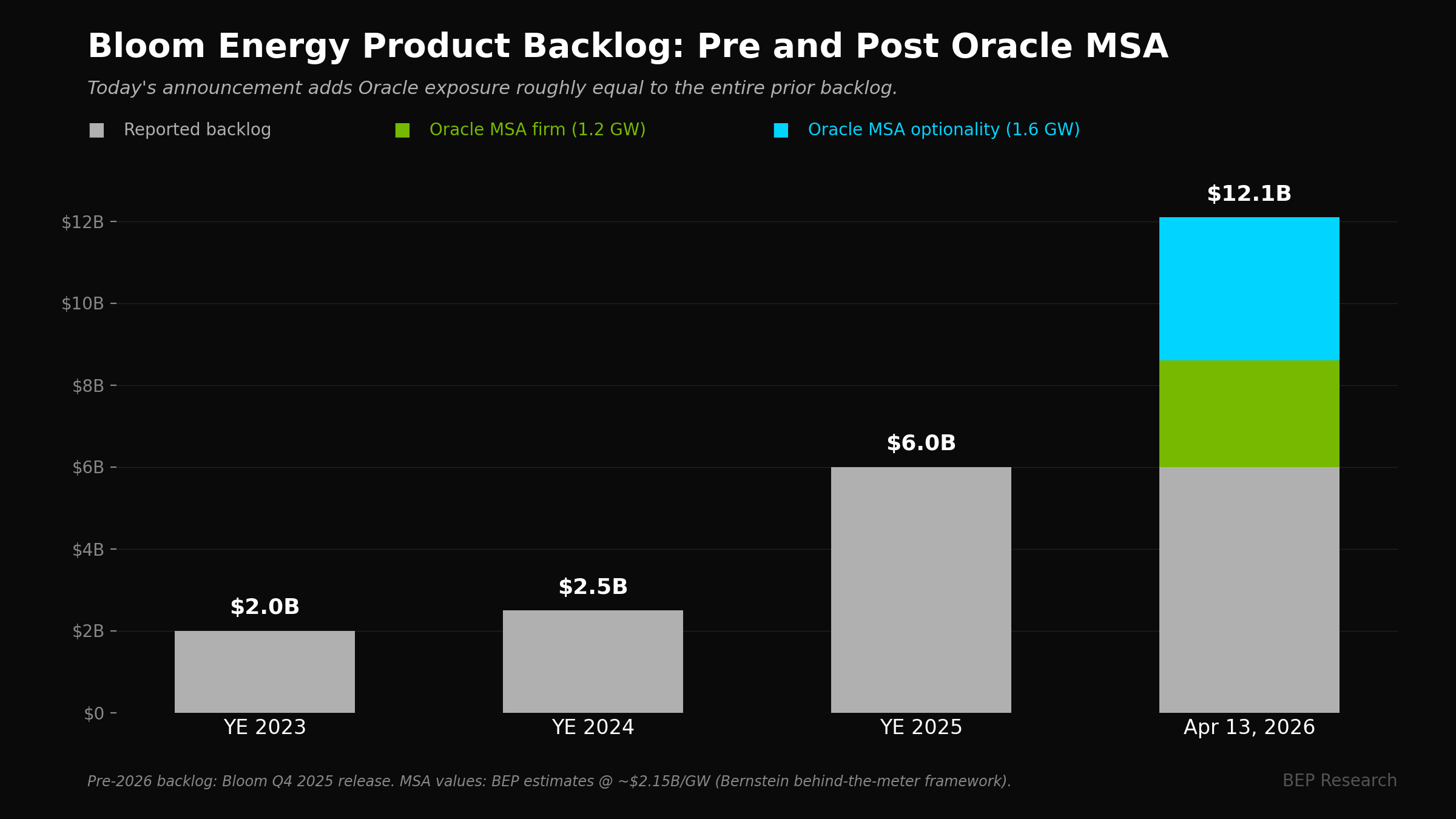
Contracted today: 1.2 GW, deploying now and into 2027.
Master agreement ceiling: 2.8 GW.
Optionality: 1.6 GW, undrawn.
The 1.6 GW of optionality is real but conditional. Oracle has to make follow-on procurement decisions to convert it. Anyone telling you Bloom just booked $5 billion of revenue is reading the press release wrong.
Here is what 1.2 GW actually represents at Bernstein’s framework of generators and turbines accounting for roughly 6% of data center capex per gigawatt, which works out to approximately $1.8 to $2.4 billion per GW of behind-the-meter generation TAM. That puts the contracted portion of this MSA at roughly $2.2 to $2.9 billion in product opportunity, before service attach. At the 100% service attach rate Bloom now runs, the lifetime contract value scales meaningfully above that.
For context: Bloom’s entire product backlog at year-end 2025 was $6 billion across six hyperscale and neocloud customers. Today’s announcement moves the Oracle slice of that book into the same order of magnitude as the entire prior book.
And that is just the firm 1.2 GW. The 1.6 GW of MSA headroom is the option Oracle paid to hold open.
The 800V DC Line Nobody Else Will Catch
One sentence in today's release tells you exactly why Oracle locked the warrant before going public. Every analyst covering this announcement will miss it. Below the paywall: the line itself, why it matters more than the gigawatt headline, the bear case I'm not going to ignore, and the Q1 call watch list. Subscribe to read the rest.
