

The Correction Landed Before the Sell-Side Did
Friday’s piece, Sold Out Through 2028: Hurlston’s Tokyo Interview and the Optical Cold War, had a Credo section I updated earlier tonight after reader pushback. The original framing I published Friday afternoon, before the correction, was this: “Their optical DSP showed impressive engineering at OFC, but a great product in a contracting market is a challenging investment thesis.” That line was wrong on both halves. A technically sharp paid subscriber sent a detailed pushback Sunday morning. He walked me through the NVIDIA platform roadmap, pointed at Cignal AI data showing no material CPO impact on pluggable transceiver shipments through the next three years, and argued that the entire bear case rested on a timeline assumption that does not match NVIDIA’s own disclosed plan of record. He was right. The Friday piece is now updated online with the corrected view, crediting the reader’s pushback and citing the NVIDIA roadmap directly. This piece is the deeper follow-up I promised at the bottom of that correction, and it is shipping the same night as the correction itself because the sell-side did not wait either.
At 4pm Pacific today, hours before this piece went live, Jefferies’ Blayne Curtis initiated coverage of Credo with a BUY rating and a $175 price target on a thesis that converges directionally with the corrected view. When a reader correction, a major sell-side initiation, and a primary source I had been sitting on for weeks all converge on the same conclusion inside a single Sunday, the piece that writes itself is the one you are reading now. The primary source is the part that changes the weight of everything else, so let me put it on the table before the rest of the framework.
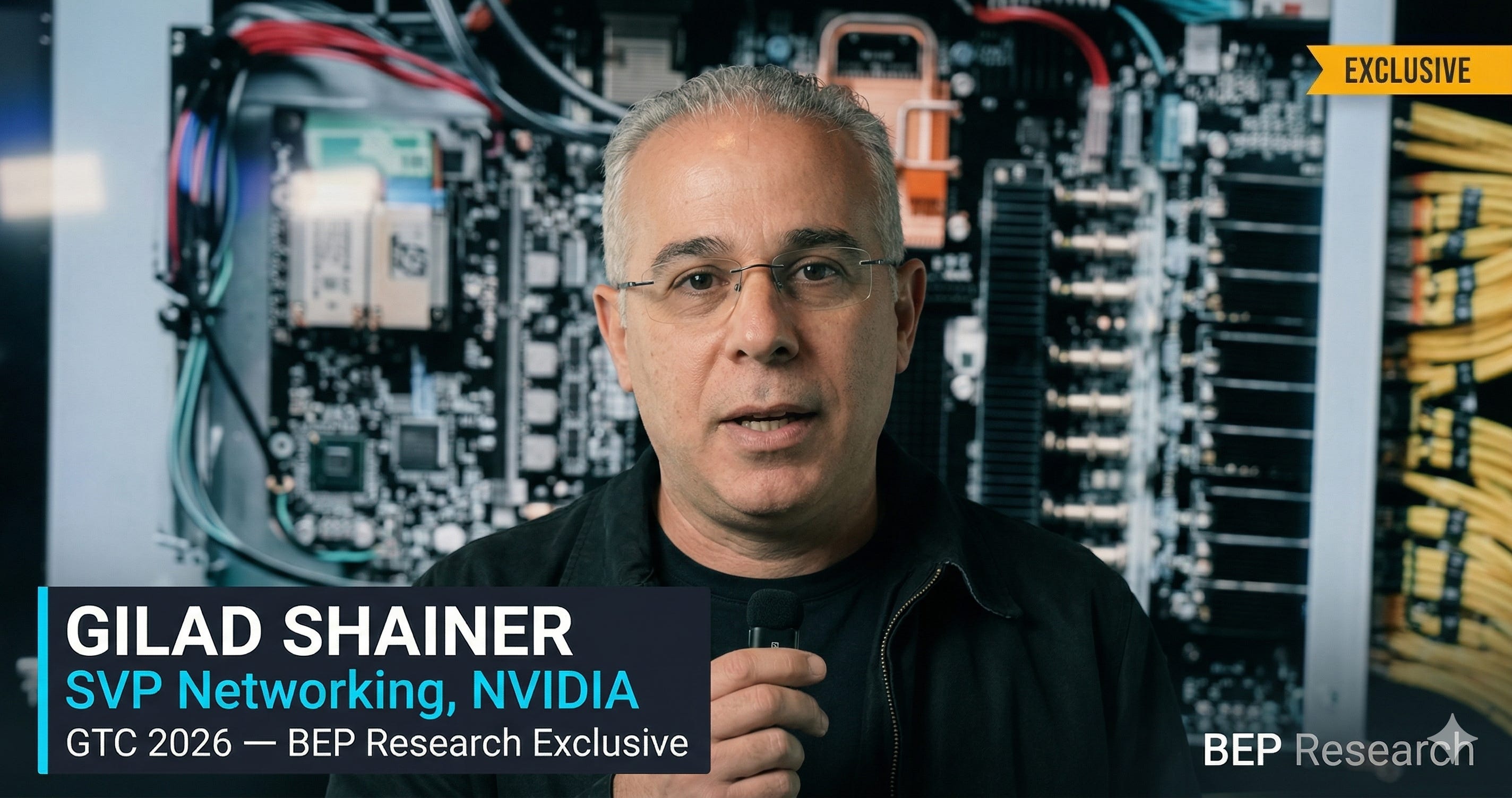
At GTC in March, NVIDIA’s SVP of Networking, Gilad Shainer, sat down with me in front of the Spectrum-X co-packaged optics demo at NVIDIA’s own booth and told me, on camera, how NVIDIA thinks about copper versus optics in the AI datacenter. His framing was as direct as a senior NVIDIA executive is allowed to be. “Everywhere you can use copper, you use copper. And the reason is that copper consumes zero power. If you can use copper, we use. Period.” He then explained why: “Power is the key element that determines my compute capacity in a given data center. I want to minimize power forever. I can.” And he put a specific timeline on when scale-up finally goes optical: “More of a 2028 story,” tied specifically to the Feynman generation when scale-up domains expand to 1,152 GPUs and the distances physically break copper. In tonight’s correction to the Friday piece, I cited Gilad’s public comments to SDX Central expressing the same view, because at that point my own footage was still unreleased. The video below is the BEP Research primary source behind that attribution, and it says the same thing Gilad has said publicly, on camera and unprompted, inside a thirty-minute conversation at NVIDIA’s booth. The consistency is the point: this is Gilad’s settled position, not a soundbite. I held the footage until now because the framework I needed to anchor it did not exist yet. The reader’s correction clarified the framework. The video goes live with it.
The Bear Case Was Asking the Wrong Question
For six months, the conversation about Credo has started with the same question. When does co-packaged optics kill copper. How fast does the AEC market shrink. Is Credo trapped in a contracting niche while the optical transition runs the company over. The bear case rests on a single architectural assumption: that CPO is imminent, copper is on borrowed time, and anything dependent on inside-the-rack copper has a terminal value problem. Both halves of that assumption are wrong, and the first half is wrong on a timeline anyone can reconstruct from NVIDIA’s own disclosed roadmap.
Vera Rubin NVL72 in H2 2026 is all-copper intra-rack scale-up. Kyber Ultra NVL144 in H2 2027 stays copper-to-switch. NVL576 connects eight Oberon racks via CPO for inter-rack links but keeps copper inside each rack. The first platform where CPO might replace copper inside the rack is Feynman NVL1152 in late 2028, and SemiAnalysis’s base case there is still copper-to-switch as plan of record because of manufacturing cost and reliability. Gilad’s “2028 story” framing on camera is the same answer as the one I wrote in Friday’s corrected section, which is the same answer the reader arrived at independently from public NVIDIA disclosures and Cignal AI data. When three vectors that started in different places all land on the same conclusion, the pattern is the signal. And it reinforces what Bill Brennan said on the February earnings call, which I covered in Credo’s Q3 Call Answered Every Question after the $407 million print: the industry remains “early in its AEC adoption.” After a record quarter, Brennan was telling us the runway had barely started. Friday’s framing forgot that. The corrected view puts it back in the model.
The deeper argument underneath the timeline is the one that actually matters, and Gilad put it directly. Power per compute is the binding constraint of the gigawatt-scale buildout. Copper consumes zero power. Optical transceivers consume measurable power at every hop. If you can cover a distance with copper, you cover it with copper, because every watt saved on interconnect is a watt spent on the GPU. CPO happens when distance physically forces it, not one moment sooner. That is the architectural worldview inside NVIDIA networking, and it is why the “use copper, period” framing is as forceful as it is. It also means the market has been modeling the wrong variable. The question is not when CPO kills copper. The question is how long NVIDIA’s power-optimization logic keeps copper inside the rack while optical volumes scale on the outside of the rack, because both can be true at the same time, and on the actual roadmap both are.
And while the market has been arguing about copper’s terminal value, Credo has been building a product that moves the company from defending one TAM into attacking a much larger one. Almost nobody in the consensus Credo model is paying attention to it.
Below the paywall: the full Gilad video, what ZeroFlap actually is and why it changes the Credo business model, the two-TAM framework that resolves the copper-versus-optics debate, what Gilad also said on camera about Lumentum and Coherent as NVIDIA’s named ecosystem partners, the bear case I am still carrying, and how the corrected view changes the Credo position inside the Optical Cold War framework.
The Gilad Video
Here is the full conversation with Gilad Shainer at the NVIDIA booth at GTC 2026, unreleased until now. It is roughly ninety seconds of primary source material that I believe is the most important on-camera commentary I have captured from a senior NVIDIA networking executive this cycle. Watch it before you read the rest of the piece, because everything below is analytical consequence of what Gilad says on camera.
What ZeroFlap Actually Is
ZeroFlap, or ZF, is Credo’s optical transceiver product line. It supports 400G, 800G, and 1.6T network speeds. The 800G version went generally available on March 17, 2026, three weeks before my Friday piece. Credo announced the line at OCP Global Summit in October 2025 and presented it jointly with Oracle, which is the anchor customer. A second hyperscaler is publicly confirmed to be in qualification. This is not a roadmap product. It is shipping.
The product targets one specific operational pain point that becomes binding at gigawatt scale: optical link flaps. A link flap is when an optical connection between two pieces of network equipment repeatedly disconnects and reconnects, sometimes hundreds of times per hour. Each flap interrupts data flow and forces the GPU cluster to retry, redo work, and waste cycles. Credo CEO Bill Brennan has said publicly that one customer was losing 20 to 30 percent of productivity to link flaps before deploying the ZF approach. You can deploy a million GPUs, but if a quarter of them are idle because the optical links keep flapping, your effective fleet is 750,000. At cluster sizes that matter, optical reliability is not a feature. It is the limiting factor on usable compute.
The ZF approach has three pieces. Hardened optics: Credo runs components through thermal stress chambers, deliberately breaks them, root-causes failures, and engineers them out, claiming two to three orders of magnitude reliability improvement over standard transceivers. Built-in telemetry: each transceiver continuously monitors bit error rates, FEC histograms, multipath interference, and laser degradation signals, which is the check-engine-light function that lets operators prevent flaps rather than chase them. And PILOT, Credo’s switch-side software that pulls the telemetry, streams it to monitoring agents, and triggers automated responses before flaps cascade across the cluster. The combination delivers what Credo calls AEC-class reliability on optical transceivers: the same uptime characteristics the company already delivers on its copper Active Electrical Cables, but in a form factor that reaches 7 to 30 meters instead of 3 to 7.
The strategic point is that Credo is no longer a copper-and-AEC company defending its turf against optics. Credo is now selling optical transceivers directly. The company has moved up the stack from SerDes, DSP, and AEC supplier to a system-level optical product company, with an anchor hyperscaler customer and a second in qualification, attacking an optical TAM that has historically been dominated by Coherent, Lumentum, AAOI, and Marvell. Jefferies frames ZF Optics as a $300 million-plus revenue opportunity by C27 in the initiation note. The consensus Credo model treats the company as what it was a year ago. It is not.
Two TAMs, Not One
The framework that resolves the copper-versus-optics debate is that there are two TAMs, not one, and they do not overlap the way the consensus bear case assumes. Co-packaged optics targets the spine and scale-up layers, where distances are long enough and link counts dense enough that the power savings from eliminating pluggables finally clear the reliability hurdle. That transition is a 2028-plus question tied to the Feynman generation, and Gilad said so directly on camera. Credo plays at the rack and row layers, where copper and short-reach optics cover physical distances CPO cannot reach economically. The architectural decision points sit at different layers of the same cluster. Both can win. On the actual NVIDIA roadmap through at least 2028, both do.
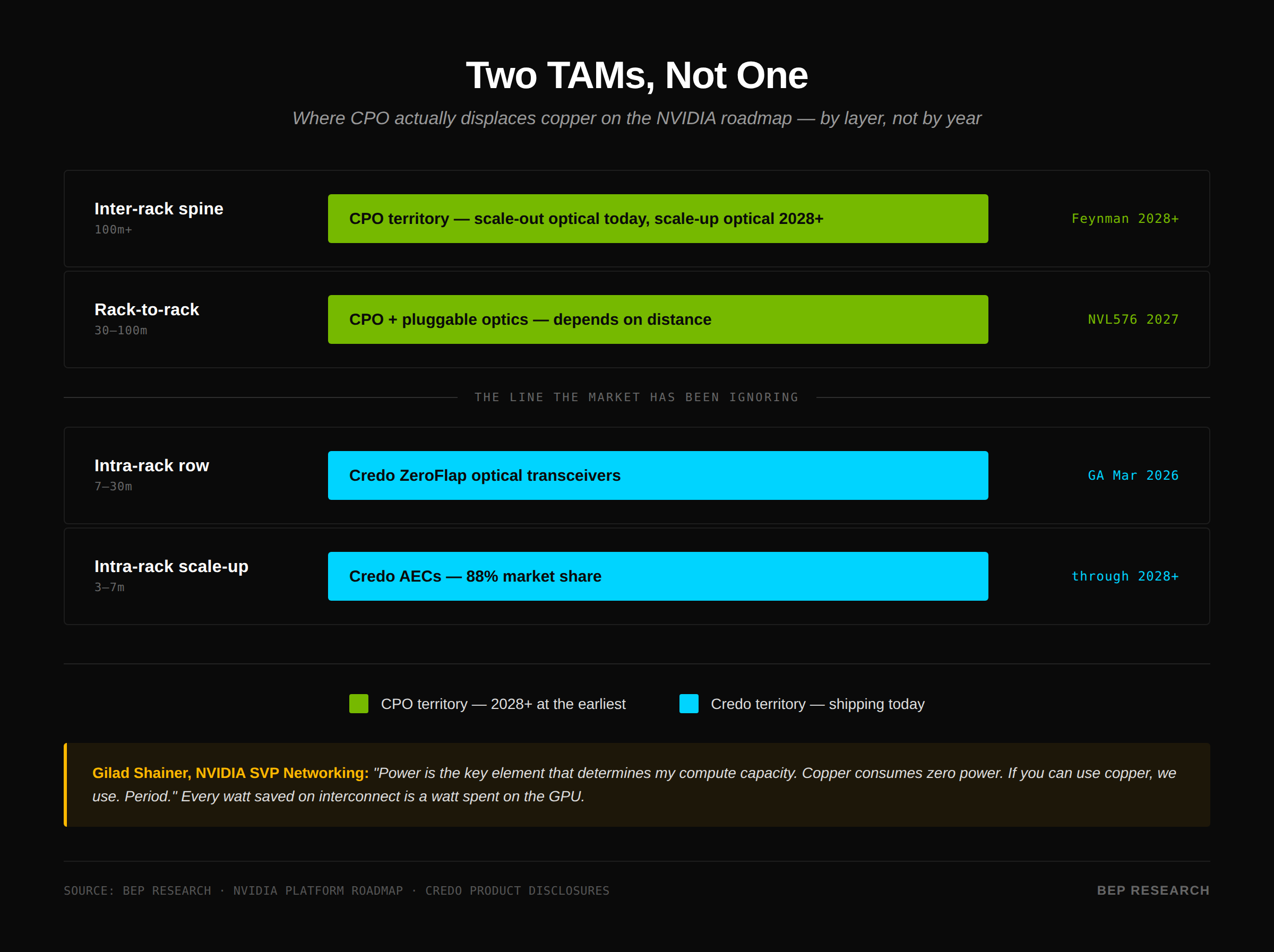
Cignal AI’s lead optical analyst, quoted in the ZF press release, put it plainly: 800G transceivers are the workhorse of AI connectivity through 2028. Every 800G and 1.6T module needs a DSP. Every one of those modules needs to hold a clean optical link at gigawatt scale. Credo’s addressable market inside that layer is not contracting. It is expanding, because the link count per cluster is scaling faster than per-link cost is deflating, and because the reliability problem ZF solves is getting worse as cluster sizes grow.
What Gilad Also Said: The Lumentum and Coherent Signal
One more piece from the GTC conversation worth surfacing, because it reinforces Camp One of the Optical Cold War framework from Friday’s piece. When I asked Gilad about the ecosystem NVIDIA was building around co-packaged optics, he was specific and unprompted about the partnerships. He told me, on camera, that NVIDIA needed to bring the ecosystem along for the CPO transition because there is going to be a lot of capacity built, and that NVIDIA wanted to invest in its partners so they build the right technology to NVIDIA’s specification. He then named the two companies directly: Lumentum and Coherent.
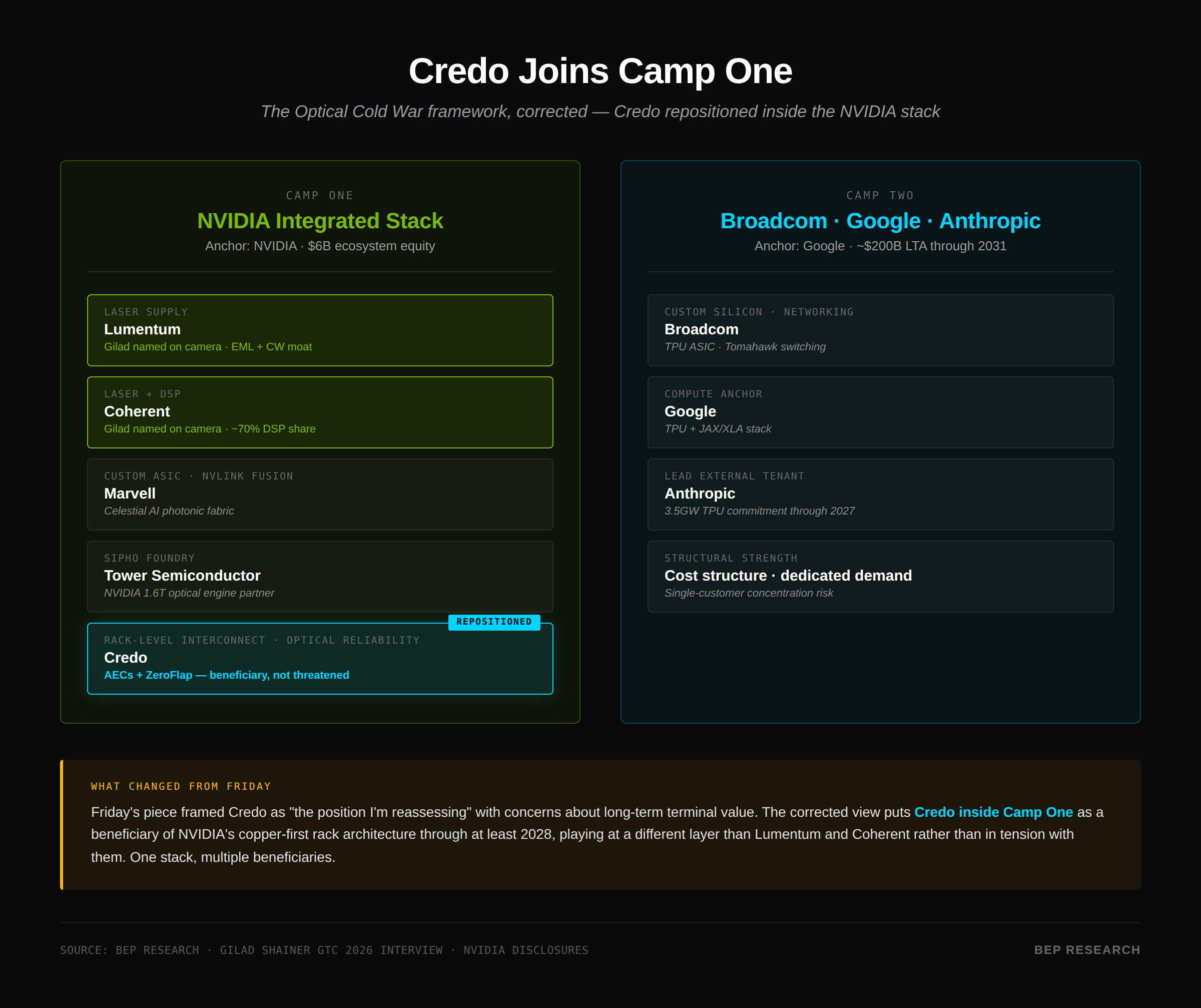
NVIDIA’s networking SVP naming Lumentum and Coherent on camera as the ecosystem investment partners for CPO is a reinforcing data point for the laser supply chain through 2028 and beyond. It is also a direct validation of the EML moat argument I laid out in The Great Photonic Divergence: “At 200G per lane, Electro-absorption Modulated Lasers (EMLs) become the required technology.” That was the structural laser argument for Lumentum at the 1.6T transition. Gilad’s on-camera naming is the NVIDIA-side confirmation of the same conclusion. The corrected view also repositions Credo inside the Cold War framework. It does not put Credo in tension with the Lumentum thesis. It puts both companies inside Camp One, playing at different layers of the same architecture, benefiting from the same NVIDIA-anchored stack.
The Bear Case
The bear case I am still carrying has two pieces, and it would be intellectually dishonest not to put them on the table. The first is execution risk on the ZF ramp. Oracle is the anchor, a second hyperscaler is in qualification, but the revenue trajectory Jefferies frames as $300 million-plus by C27 assumes qualification timelines hold and additional hyperscalers sign on over the next several quarters. Optical reliability products live or die on field data from the first deployment year, and ZF 800G is less than a quarter into general availability. If early field data disappoints at any hyperscaler, the TAM expansion thesis compresses fast and the stock goes back to being priced as an AEC incumbent with an optical side project.
The second is the terminal value question at Feynman and beyond. Gilad’s “2028 story” framing on camera is my base case too, but if the Feynman architecture settles on CPO-inside-the-rack earlier or more aggressively than SemiAnalysis currently models, the Credo AEC runway shortens and the company becomes more dependent on ZF Optics carrying the growth alone. That is still a better position than the Friday framing implied, but it is a concentrated bet on one product line through a platform transition. I am holding with renewed conviction. I am not claiming the long-term question is closed, and the next twelve months of field data are what settle it.
So What?
Position corrected: Credo. The Friday framing was wrong on both the timeline and the TAM. The corrected view puts Credo inside Camp One as a beneficiary of NVIDIA’s copper-first rack architecture through at least 2028, with a second growth vector in ZF Optics that the Friday piece did not model. Holding with renewed conviction, considering adding on the next pullback.
Thesis reinforced: Lumentum and Coherent. NVIDIA’s SVP of Networking naming both on camera as ecosystem investment partners for CPO strengthens the laser supply chain leg of the Cold War framework and the Lumentum position specifically.
Framework holds: the Optical Cold War. Camp One still anchors on NVIDIA’s vertically integrated stack. Camp Two still anchors on the Broadcom-Google-Anthropic axis. The corrected view clarifies that Credo sits inside Camp One at the rack-level interconnect layer rather than in tension with it.
Signal to track: the ZF Optics qualification pipeline beyond Oracle, early field reliability data at the first 800G deployments, any Feynman architecture disclosure from NVIDIA that tightens or loosens the 2028 CPO timeline, and the Hyperlume microLED acquisition as a wildcard for the 2028-plus optical interconnect mix.
Unresolved tension: the sell-side initiated on the corrected view hours before this piece published, inside the same Sunday the reader correction landed. When independent vectors converge that fast, the easy trade is already partially in the stock. The harder question is whether ZF ramp execution holds through the 2026-2027 deployment window, because that is what determines whether Credo becomes a multi-product optical company or stays the AEC incumbent with an optical side project. The execution is the signal. The narrative is already priced in.
Coming Up
Friday’s corrected Credo section flagged that a follow-up with direct management commentary was in motion. This piece is the Gilad-anchored primary-source installment of that follow-up. The management conversation is still being scheduled through the same reader who flagged the correction, and a second follow-up with Credo’s optical leadership on the CPO transition timeline, the ZF Optics customer pipeline, the Hyperlume microLED acquisition strategy, and the terminal value framing will publish when that conversation happens. The Gilad video stays exclusive to paid subscribers for the next 24 to 48 hours before cross-posting to the BEP Research YouTube channel, X, and LinkedIn.
Other items still on the calendar from Friday’s piece: Google Cloud Next April 22-24 in Las Vegas, the Phil Lapsley interview at the Embedded Vision Summit on May 12, and the JP Buzzell meeting with Eaton on power infrastructure for AI data centers. As I wrote in The Token Dollar, the dollar-denominated supply chain underneath all of this is the quiet structural winner of both camps of the Cold War, regardless of which AI stack ends up in front.
Disclosure: I hold positions in NVDA, LITE, CRDO, TSEM, and others disclosed in my portfolio. I am considering opening a position in MRVL. I do not hold positions in COHR, AAOI, AVGO, or GFS. This is not investment advice — do your own research.