



Traders on the NYSE floor during Circle Internet Group’s IPO in early June 2025.
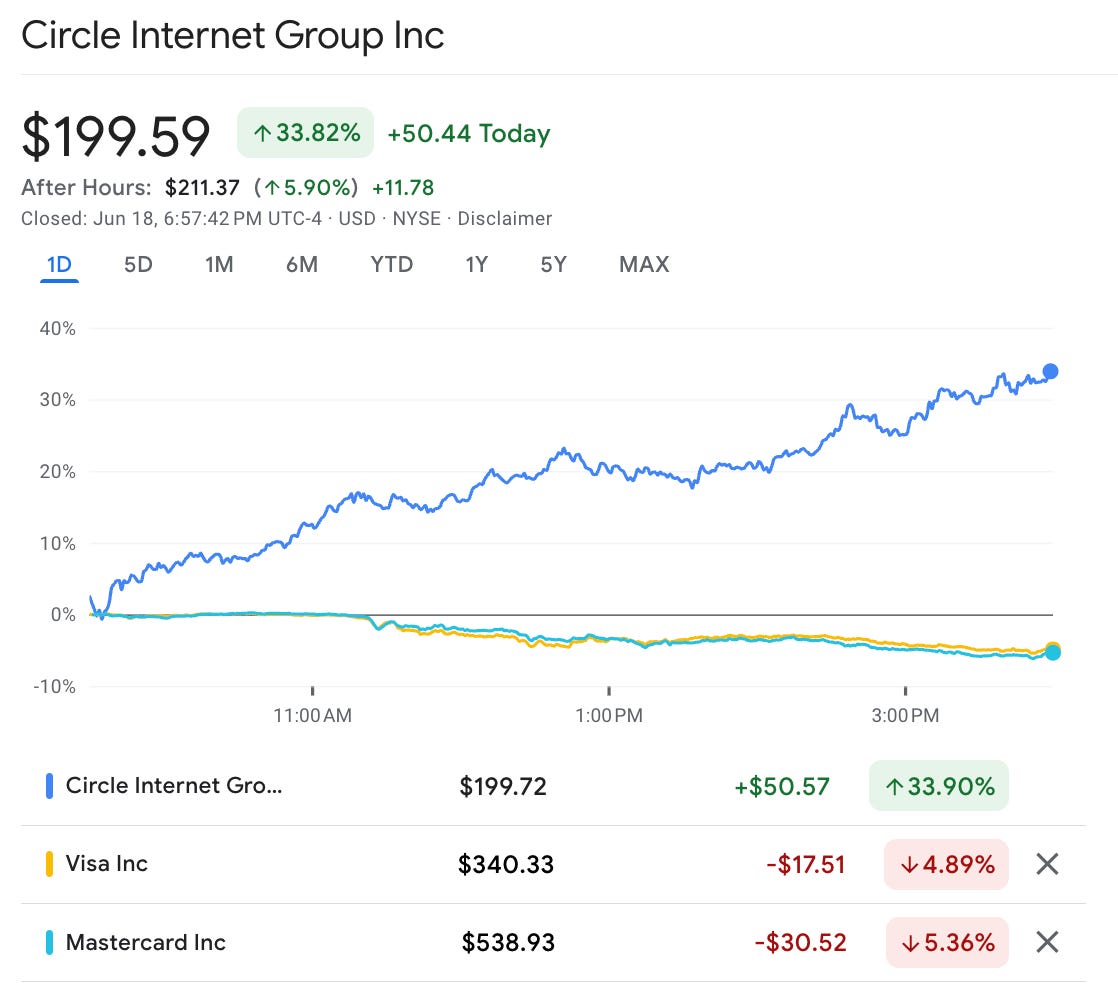
Circle’s stock surged from its $31 IPO price to over $200 within days, a stunning debut that sent shockwaves through the payments industry . As the issuer of the USDC stablecoin (a digital dollar token), Circle’s public market success was more than just another tech IPO – it was a signal that blockchain-based dollars are stepping onto the mainstream stage. On Wall Street, the reaction was telling: shares of payment giants Visa and Mastercard slid by ~4–6% in the immediate aftermath, as investors grappled with a new reality . The message was clear: Circle’s rise could spell direct competition for traditional credit card networks, raising the question of whether transaction volume in the payments world is a zero-sum game – one where every dollar of payment that flows through USDC’s rails is a dollar not routed through Visa or Mastercard.
Circle’s Big Debut and Why It Matters
Circle Internet Financial’s IPO – coming to market at a $6.9 billion valuation and soaring nearly 170% on Day One – wasn’t just another fintech listing; it was a watershed moment for stablecoins and digital finance . The company behind USD Coin (USDC) raised over a billion dollars and instantly became a market darling, underscoring investor confidence in the future of blockchain-based money. By mid-June, Circle’s shares were trading around $173 (up over 450% from the IPO price) , reflecting euphoria about USDC’s growth prospects.
Why are markets so excited? USDC is a stablecoin – a crypto token fully backed 1:1 by dollars – meaning it combines the stability of the U.S. dollar with the technological advantages of crypto networks. Circle’s successful debut suggests that stablecoins are moving from the fringes of crypto into the financial mainstream. In fact, total stablecoin transaction volume reached $27.6 trillion in 2024, exceeding the combined volume of Visa and Mastercard transactions . That staggering figure indicates that, at least in raw throughput, blockchain payment rails can already handle “Visa-scale” load . Circle’s IPO put a spotlight on this trend, raising alarms for incumbent payment companies that a new competitor has arrived at scale.
Visa and Mastercard, for their part, have enjoyed decades of dominance in electronic payments – building a global duopoly of card networks that connect consumers, merchants, and banks. They earn a tiny fee from every swipe or tap – fees that added up to an estimated $148–224 billion in U.S. merchant charges last year (via interchange and other processing fees). It’s a lucrative model that has until now faced few threats. But Circle’s rise – and the adoption of USDC – represents a direct challenge to this legacy business model, because payments is largely a zero-sum game. If a growing slice of transactions move to new rails, the incumbents lose an equal slice of their fee-based volume .
Stablecoins’ Edge: Speed, Low Fees, and Programmability
Why would merchants, businesses, or consumers consider using USDC stablecoins instead of card networks? The core advantages of blockchain-based payments boil down to speed, cost, and flexibility:
Instant Settlement & 24/7 Availability: A USDC transaction can settle in seconds (depending on the blockchain) and can be sent anytime – nights, weekends, holidays – without waiting . In contrast, card payments involve batch processes: authorization is instant, but final settlement to merchants can take a day or two, and banks don’t move money on weekends or off-hours. Stablecoins operate on internet time, which perfectly suits the always-on global economy and e-commerce .
Lower Fees & Cost Efficiency: Every time you swipe a Visa or Mastercard, a fee of roughly 2–3% is levied (mostly via interchange) – a cost typically passed along in higher prices to consumers or absorbed by merchants . Stablecoin payments, by contrast, can be extremely cheap. Transferring USDC is akin to handing over digital cash: “like paying with a $20 bill on the internet” with virtually no middleman fee . A merchant accepting USDC could save that 2–3% cut, either boosting their margin or enabling lower prices for customers . It’s no wonder big retailers are intrigued – reports surfaced that Amazon and Walmart have discussed issuing their own stablecoins to streamline payments and avoid hefty card fees . This prospect alone wiped out over $60 billion in market value from Visa and Mastercard in a single day, as their stocks plunged 5–7% on the news .
Programmability & Innovation: Perhaps the most subtle advantage is that stablecoins are programmable money. Developers can integrate USDC into smart contracts and software, enabling automatic, conditional payments and new financial products. Circle has capitalized on this by offering APIs for businesses to embed USDC payments into invoices, payroll, e-commerce marketplaces and more . USDC now exists natively on 20 different blockchains, and Circle even built protocols to let users send USDC across chains seamlessly . This level of flexibility and innovation – often termed “money Legos” in the crypto world – has no real analog in the traditional card networks. Visa and Mastercard’s systems are comparatively rigid, built for swiping cards in face-to-face transactions. By contrast, stablecoins can power anything from micropayments in a gaming app to real-time global remittances, all at the speed of the internet.
These advantages make a compelling case that stablecoins aren’t just a niche crypto experiment, but a better mouse trap for many types of payments. For example, in cross-border business-to-business transactions and remittances, using a regulated digital dollar like USDC is “an operational upgrade over banking and card networks”, delivering funds in seconds with lower friction . Migrant workers sending money abroad, or companies funding international invoices, can save time and money by using stablecoins instead of waiting days for wire transfers or paying high FX and card fees . In such use cases, USDC isn’t competing with Visa at the checkout counter – it’s leapfrogging legacy rails like SWIFT and Western Union. But over time, as stablecoins become more user-friendly and trusted, they inch closer to Visa and Mastercard’s home turf of everyday consumer payments.
Undermining the Legacy Payment Model
For Visa and Mastercard, all this spells a genuine threat to their decades-old business model. The card networks operate a four-party payment model (cardholder, issuing bank, merchant, acquiring bank, facilitated by the network) that earns revenue through toll-like fees on each transaction. This model thrives on ubiquity and trust: billions of cardholders and millions of merchants rely on it daily, confident that a Visa swipe “just works” worldwide. However, stablecoins like USDC undermine several pillars of this model simultaneously:
Interchange Fee Pressure: If merchants (especially large ones) begin routing significant volumes through stablecoins, it directly erodes the interchange fee revenue that issuers (and by extension networks) collect. Even a small shift of volume off of cards has a significant impact, as one payments strategist noted: “What if merchants migrate from card networks to blockchain rails? Even a small shift could have a significant impact… as issuers charge 0.2% to 3% for every transaction.” In a business where margins per transaction are thin but scale is enormous, losing transactions to a lower-cost rail is devastating. It’s essentially revenue that disappears into the crypto economy.
Disintermediation: Stablecoins allow peer-to-peer digital transactions without traditional bank or network intermediaries. If a customer can load dollars into a digital wallet and pay a merchant directly in USDC, the role of the card network and acquiring bank can shrink. Blockchain rails perform the clearing and settlement. Over time, with user-friendly fintech apps and merchant integrations (say, a future Stripe plugin that accepts USDC), the need for a plastic card and a point-of-sale terminal could diminish. That challenges the very raison d’être of networks built to connect those pieces. Indeed, we’re already seeing early signs: fintech innovators like Stripe and Shopify are piloting stablecoin payment options in anticipation of wider adoption .
Global & Real-Time Reach: Visa and Mastercard pride themselves on global acceptance. But stablecoins are inherently global – a USDC token sent from a user in the U.S. to a merchant in Europe encounters no different friction than a domestic U.S. payment. There’s no need for currency conversion if both sides use a USD stablecoin. And unlike card networks that must patch together local bank systems in each country, a stablecoin operates on a single, unified ledger (the blockchain) that anyone can tap into worldwide. In effect, stablecoins create a real-time, universal value transfer network that parallels (and in volume terms, already exceeds) the card networks . This erodes the value Visa/Mastercard provide as international payment intermediaries, especially for online commerce.
None of this is to say Visa and Mastercard will vanish overnight. They still have major advantages: nearly every consumer has a credit or debit card, and every merchant knows how to accept them. Trust and habit are powerful moats – consumers and merchants may be slow to change methods, especially when stablecoin payments today still require a bit more tech savvy (e.g. crypto wallets, QR codes) than simply tapping a card. Additionally, card networks offer fraud protection, dispute resolution, and credit underwriting (in the case of credit cards) that pure blockchain payments do not inherently provide. These factors mean incumbents won’t be displaced easily. But the threat from stablecoins is no longer theoretical; it’s manifesting in specific niches and growing each quarter. And importantly, investors now see it too.
Market Reaction: Visa & Mastercard Feel the Heat
Nothing crystallizes a competitive threat quite like the stock market’s vote. In recent weeks, investor sentiment has shifted in favor of Circle and other crypto players, and against the traditional card networks, following key news on stablecoins:
Circle’s IPO Pop: When Circle’s IPO soared, it wasn’t just crypto enthusiasts who took note – Visa and Mastercard shareholders panicked. The day Circle began trading, Visa and Mastercard stocks each fell around 4–6% as the market digested the implications . A $25 billion stablecoin company surging in value so quickly was a wake-up call: Wall Street suddenly saw tangible evidence that a crypto startup could be worth a chunk of what the payment giants are worth, owing to its growth potential in payments. As one commentator put it, “we are seeing real fear” among the incumbents’ investors .
Retail Stablecoin Plans – $60B Shock: A few days later, an even more direct threat hit the news. The Wall Street Journal reported that Amazon and Walmart – two of the world’s largest retailers – have been exploring launching their own stablecoins. The idea that huge merchants might bypass Visa/Mastercard by creating digital dollars for payments caused Visa’s stock to tumble as much as 7.1% and Mastercard 6.2% intraday, their steepest drops in over a year . In one session, over $60 billion in combined market cap evaporated from the two companies. Clearly, the market believes that if anyone has the clout to make consumers adopt a new payment method, it’s Amazon and Walmart – and if they succeeded, it would cut directly into card network volumes .
Regulatory Breakthrough – Crypto Stocks Soar: On June 18, the U.S. Senate passed the landmark “GENIUS Act” stablecoin bill with bipartisan support, a major step toward federally recognizing and regulating stablecoins . The prospect of clear rules turbocharging stablecoin adoption sent crypto-related equities flying: Circle’s own stock jumped 20%, Coinbase leapt 14%, and other fintech names like Robinhood ticked higher . Meanwhile, Visa and Mastercard shares sagged a few percent on the news, reflecting the flip side of that optimism . Analysts at Bernstein framed it this way: once stablecoins have a green light, they could evolve from “the money rail of crypto to the money rail of the internet” – implying a much broader use in payments that could siphon volume from traditional rails. In other words, investors now expect stablecoins to capture a meaningful share of future payment flows, to the detriment of incumbents.
Viewed together, these market reactions underscore a crucial point: the competition for payment transactions is increasingly seen as zero-sum. If Circle and USDC win, Visa and Mastercard must be losing, and vice versa. There’s only so much payment volume to go around, and growth in one network often means a rival network’s loss. It’s a dramatic shift in narrative from a few years ago, when crypto was considered largely irrelevant to mainstream payments. Now, the largest payment firms’ stock prices literally rise and fall based on stablecoin news. That’s a profound change in investor perception – one that validates the notion that stablecoins pose a major competitive threat to legacy payment rails.
Incumbents Strike Back: Adaptation or Disruption?
Facing this threat, Visa and Mastercard are not sitting idly by. Both companies have publicly acknowledged the promise of stablecoins and blockchain, and they’re investing to integrate crypto into their own networks. Visa’s CEO has referred to stablecoins as potentially “additive to our network, if done right” in past remarks, and the company has launched initiatives to help banks and fintechs issue their own stablecoins on Visa’s network . In fact, Visa ran a pilot program settling transactions in USDC on the Ethereum blockchain for one of its partners, signaling a willingness to use stablecoins for moving funds between financial institutions . Similarly, Mastercard has unveiled a program called “Mastercard Multi-Token Network” aiming to support digital assets and stablecoin transactions alongside its card network. Both giants are effectively saying: if stablecoins are the future, we’ll ride along rather than get left behind.
However, there’s a delicate balance for the incumbents. On one hand, embracing stablecoins could yield new revenue streams (like providing custody, wallet, or exchange services, or charging for stablecoin transactions on their platforms). On the other, widespread stablecoin adoption could cannibalize their core business of card payments. It’s a classic innovator’s dilemma: how to participate in the new paradigm without accelerating the demise of the old one. So far, Visa and Mastercard appear to be hedging – investing in crypto tech and partnering with fintechs, while still defending their interchange-fee economic model in lobbying and business negotiations. Notably, both networks continue to lobby against proposals to cap interchange fees, and tout the value they provide in security and fraud reduction, implicitly making the case for why their fees are justified.
Regulation will also influence how this battle plays out. The GENIUS Act, if it becomes law, would enforce that stablecoin issuers like Circle hold fully reserved dollars and undergo audits . Paradoxically, regulation could make stablecoins more competitive by legitimizing them and instilling public confidence – potentially encouraging more businesses to accept USDC, knowing it’s overseen by regulators similar to banks. Visa and Mastercard seem to recognize this; they’ve supported some regulatory efforts, likely calculating that if stablecoins are inevitable, it’s better they operate in a regulated, interoperable way (perhaps one the card networks can facilitate or tap into) than in a wild-west fashion. Still, as regulation smooths out the road for stablecoins, the pressure on legacy payment fees and practices will intensify.
A Zero-Sum Game for Payments Dominance?
The coming years will reveal whether Circle’s rise truly marks the beginning of a tectonic shift in payments or simply adds a new layer to a complex ecosystem. It’s tempting to view the contest as “old vs new” – stablecoins versus card networks – with a zero-sum outcome: one wins, the other loses. In many ways, that framing holds truth. Every transaction that migrates to a blockchain rail is revenue that Visa and Mastercard don’t get, and if stablecoins were to eventually handle hundreds of millions of daily purchases, the legacy networks would be hard-pressed to maintain their current economics.
Yet in the near term, coexistence is likely. Consumers aren’t abandoning their credit cards en masse for crypto wallets tomorrow. Stablecoins will probably grow first in areas where they clearly outperform – think cross-border transfers, B2B payments, treasury management, and digital-native commerce – nibbling around the edges of Visa and Mastercard’s empire. During this phase, the card networks can continue to grow in traditional retail payments, albeit at a slower pace if economic conditions and fintech competition squeeze them. The real inflection could come when (or if) stablecoins become as easy to use as Apple Pay or credit cards for average consumers. Fintech apps are racing to abstract away the crypto complexity, so that a user might be paying via USDC under the hood without even realizing it. When that day comes, the competitive boundary between a “Visa transaction” and a “USDC transaction” could blur – but it will matter immensely to the companies’ bottom lines who ultimately processes the payment.
For now, Circle’s blockbuster IPO and the market’s reaction have been a shot across the bow of the payment establishment. The narrative has shifted: no longer are Visa and Mastercard guaranteed perpetual growth simply because cash is declining. They now face a new kind of competitor — one that doesn’t need a card, a bank, or even a user-facing app to move money, just a blockchain. In the zero-sum battle for transaction volume, stablecoins have arrived as a formidable contender, backed by deep-pocketed investors and growing public policy support. Visa and Mastercard still hold powerful cards (global brand, trust, scale), but the game has changed. As Circle’s CEO put it when the stablecoin bill passed, “history is being made”, and stablecoins are poised to become “the money rail of the internet” . If that vision pans out, the balance of power in payments could tilt dramatically – and the swipes and taps of today may eventually give way to the tokens and hashes of tomorrow.