


Elon Musk says SpaceX can shorten turbine waits by casting blades and vanes in-house. Blake Scholl’s Boom Supersonic is developing turbines for AI data centers. When rocket and supersonic-aircraft companies enter the power business, the bottleneck is hard to miss.
Bloom’s answer is already here: modular fuel cells that make DC power. Its new paper puts the native-800V architecture to work with NVIDIA H100 servers. What can the customer stop buying?
I’m still long. I don’t see the AI buildout slowing down, and after nearly 25 years, I think Bloom has found its defining market. Faster power, fewer upstream boxes and less community resistance make a compelling combination.
I’ve covered Bloom since December, through short attacks and corrections to my own work. Now I’ve put the questions directly to its engineering and commercial leaders, on the record.
The principle predates this paper. In my April conversation with JP Buzzell, then Eaton’s VP and Data Center Chief Architect, I learned that the IT workload drives the power architecture. Bloom is showing how that principle can change the equipment list.
Carl Cottuli, Bloom’s Head of Development Engineering, captured the problem on my September 17 call. Data centers get the chance to build their own power, he said, and “They make a grid. They replicate the grid. And that’s what just astounds me.”
From the Module to the Rack
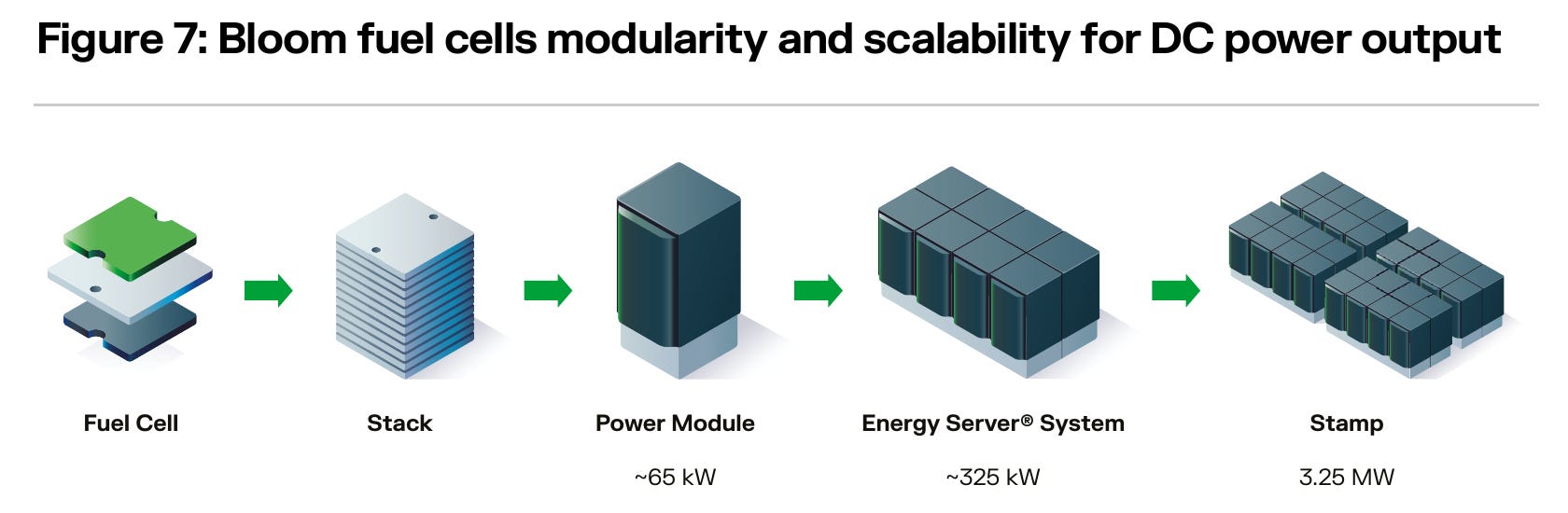
Bloom builds capacity in blocks: fuel cells become stacks, power modules, Energy Servers and 3.25 MW stamps.
The electrical path still has work to do. A DC/DC converter regulates the output; Bloom quotes 98-99% efficiency for that stage. Ultracapacitors absorb or supply rapid bursts while the fuel cells adjust. Protection, distribution and lower-voltage conversion at the rack remain.
The demonstration ran Llama 2 and Stable Diffusion workloads on three H100 servers, with a 30 kW Llama 2 load profile. The response belongs to the combined fuel-cell, converter and ultracapacitor system.
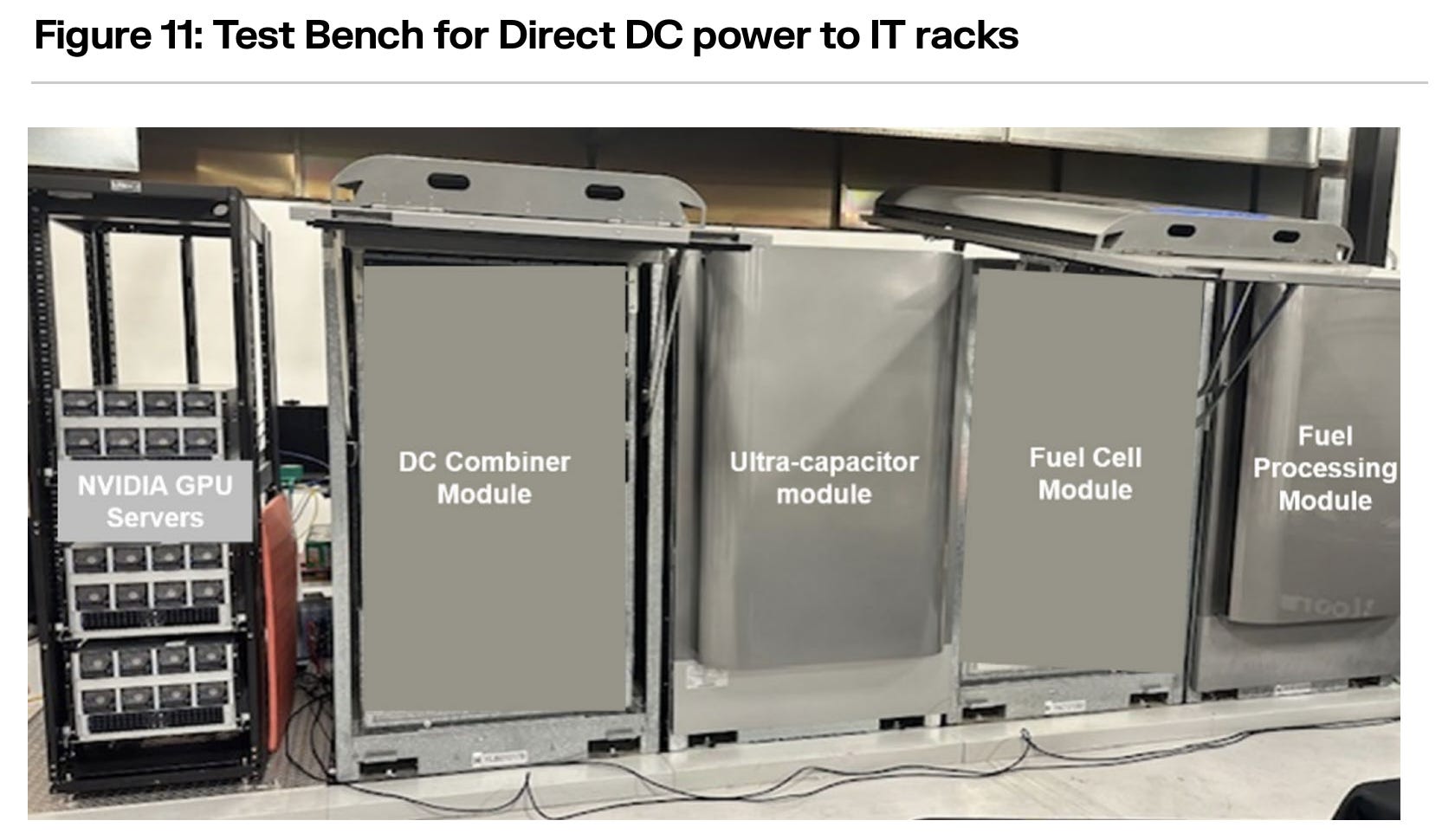
That is real engineering progress. When I asked about commercial customers taking native DC into production racks on September 17, Bloom’s Bala Naidu answered, “Not that I’m aware of.” The new paper documents the testbench; it does not name that commercial customer.
The money comes from Bloom’s separate September 16 cost report. For a modeled 1 GW site, five-year non-compute costs fall from $26.7B on standard grid AC to $25.1B on grid-fed 800V DC, then $21.2B on Bloom-fed 800V DC. $1.6B comes from changing voltage. Another $3.9B comes from changing the power source and associated equipment.
Explore our free Path to the Rack interactive to see the equipment, conversion stages and functions that remain.
I’m long Bloom. The numbers still have to hold up. Upgrade to paid for the assumption Bloom confirmed to me, our power-price and equipment-cost stress tests, and what they mean for my Bloom and Wolfspeed holdings.
For investment teams: discuss institutional research with BEP.
