


You got the headline numbers in the chat during the call. Here is the rest, shorter and blunter than the public post. And my read up front: I know the stock has sold off recently with the whole momentum drawdown, but the story stays intact, and so does the confidence of the CEO on this call. He has been waiting two decades to get to this moment, and they have achieved product-market fit. Or as I put it to Jack Farley three weeks ago: “20 years, no product market fit. And all of a sudden became like the killer app.”
The print in three numbers
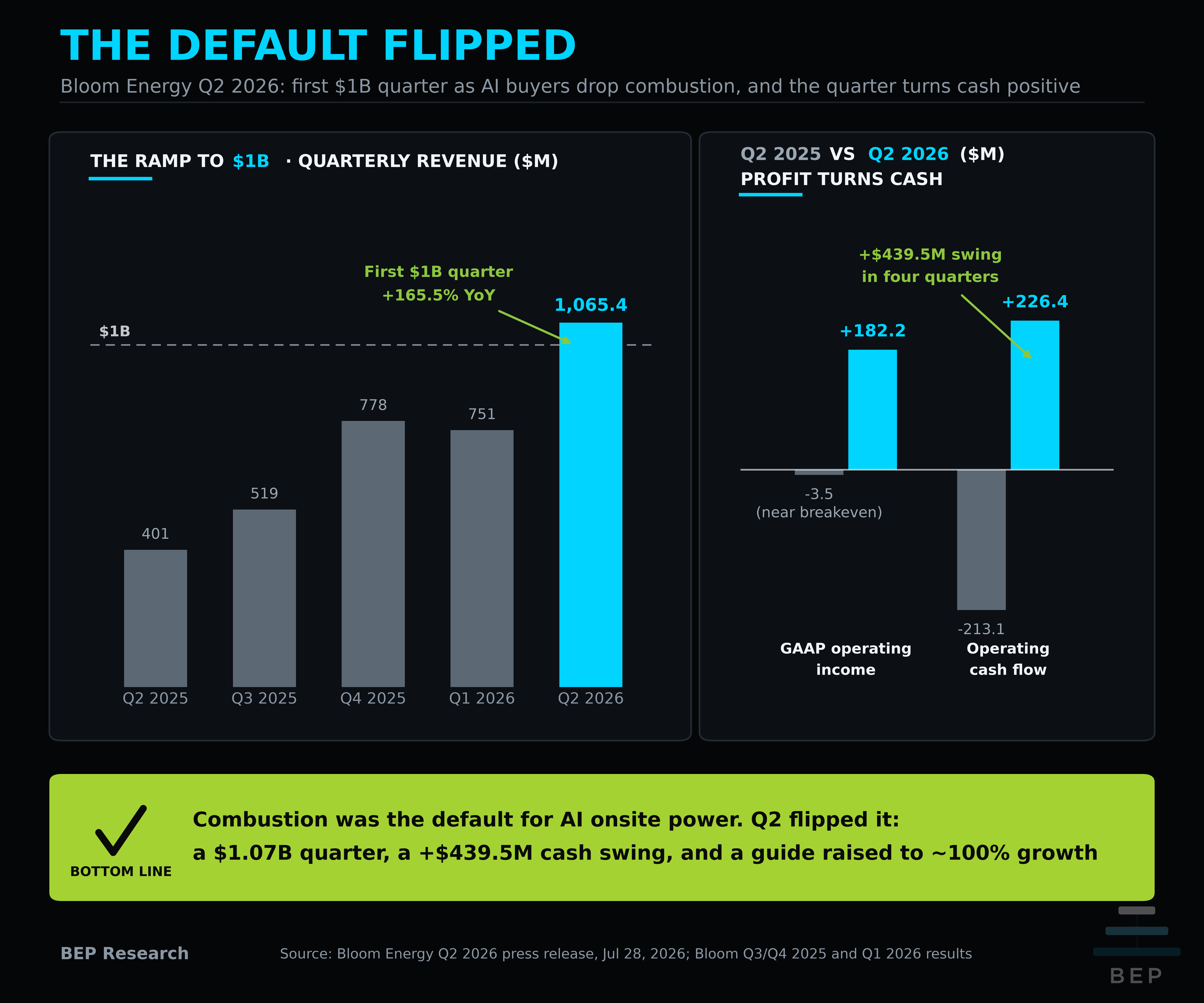
Revenue $1,065.4M, up 165.5%, the first quarter over $1B. Operating cash flow $226.4M against $213.1M of cash used a year ago. And the one that matters most for the model: the EPS guide midpoint went from $2.05, the number I flagged for you in April in What Wall Street Missed in Bloom’s Q1 Call, to $2.70. A 32% raise on a guide they had already raised once. They were supposed to be defending $3.4B to $3.8B tonight; they raised to $3.9B to $4.2B instead. The shares jumped after hours.
What the call added
The line of the night: “We think a four-year backlog is not a trophy. It is a confession of constrained supply.” Aimed straight at the turbine incumbents selling 2029 delivery slots as strength. Management also repeated, twice, that the backlog is growing faster than revenue. Treat that one with care: it reads as an implicit answer to the short report, but they never named it, and a faster growing backlog says nothing about whether the backlog is auditable. Claim, not reconciliation.
One thing people need to really understand is that time to power is the whole argument. You can’t wait three or four years for a turbine from GE Vernova; these projects have to get online. And the call tied it to the reason communities fight data centers in the first place: air quality and noise. Bloom answers both. No combustion, negligible air pollution next to turbines and engines, negligible water use, and a server that runs quieter than air conditioning, so communities welcome it and air permits come faster, with management’s line that “every month saved on permits is a month closer to power availability.” I was making exactly this argument on Monetary Matters with Jack Farley three weeks before the call made it: Bloom is “quiet energy for the data center and it ships fast... Time to power is everything,” while the turbine alternative is “noisy and weird. That’s not the data center of the future.”
The most important new fact of the night: customers who had ordered combustion turbines and reciprocating engines cancelled those orders and chose Bloom. Nebius (NBIS) did it this quarter, one of the dozen-plus neoclouds on that roster.
It cuts the other way too. Even the reported New Mexico cancellation: the products get diverted somewhere else, because the products are fungible. Management’s word for it in Q&A was that “every project in the portfolio is fungible.” Mine is that he has built a whole Lego system. Not a big deal.
Track the roster against this letter’s own record. In February the stat that stopped me cold was “six hyperscale and neocloud end customers. A year ago, it was one”. In May, after the Q1 print, I wrote Bloom was “no longer a thesis. It is the emerging industry standard”. Tonight the CEO used the word standard himself, for all the major US hyperscalers plus over a dozen neoclouds. One to six to all of them in twelve months is the demand curve. But the Q&A reading I would give you over dinner: management would not split that roster into operating units versus in-construction versus signed paper, and that refusal is the honest tell about where this actually stands. The rest of the color: “It took us ten years” to become the standard in commercial and industrial, “I never thought within nine months we would become the standard” in AI, “This is not a faster horse. This is a car.” And scandium got exactly three sentences (enough economically recoverable supply, visibility for 25 GW of deployments, not dependent on China) before everything else was declared proprietary. A refusal to disclose is a position. My offtake gate stays open.
The numbers behind the numbers
The full cash bridge and H2 arithmetic are in the public post; the short versions. Cash: the gap between operating income ($182.2M) and operating cash flow ($226.4M) is only $44.2M, so cash tracked earnings rather than working capital games, with the standing caveats (customer deposits, part-owned JVs, and operating cash flow is not free cash flow). Guide shape: the raise implies H2 quarters roughly flat to Q2 at the midpoint and below Q2 at the low end, after a 41.8% sequential Q2. That is the shape of the guide and you should know it before the sell side finds it. Margin: 34.3% non-GAAP, slightly above the top of the guided 32 to 34% non-GAAP band; 33.4% GAAP against 26.7% a year ago. That is the April disclosure, “Ten times the output, same headcount on the floor”, delivering roughly the 200 bps I scoped to it then, not the whole expansion.
The cleanest way I am wrong: the cash swing is not independent evidence. Cash collected in advance against the same disputed backlog is the same claim arriving earlier, and if the 10-Q shows the operating cash flow print leaning on deposits and related-party collections, the wedge I have been leaning on weakens with it.
Targets
In April I told you: “Holding targets pending Q2 backlog composition, any second MSA-style announcement, and the actual cadence of Oracle deployment hitting revenue. Current targets from February: 1-Year (YE 2026) $225+, 5-Year Upside $600+, Downside Risk $80-100. Likely revision direction is up on the one-year given the EPS guide, neutral to up on the five-year given the inference TAM expansion.”
(Targets and promise from What Wall Street Missed in Bloom’s Q1 Call, April 28; the February targets from Bloom Energy Q4 Update: The Backlog Just Doubled, February 6.)
Q2 has now printed.
My targets are unchanged tonight: 1-Year (YE 2026) $225+, 5-Year Upside $600+, Downside Risk $80-100. In April I said the likely revision direction was up on the one-year, and after this print that is still the direction. But I set the condition then and I am keeping it now: the revision waits for the backlog composition in the 10-Q, the RPO reconciliation, and the related-party mix. The print cleared the profitability bar. The filing clears the target revision. What changed tonight is my position, not my targets: I am adding at these levels and holding the numbers until the 10-Q.
For the multiple: at the pre-print $184.89 close, the new $2.70 midpoint puts BE near 68x forward, down from the north of 110x I flagged in April, and higher again after the after-hours move. Cheaper against its own guide, not cheap.
The 10-Q checklist
What actually resolves the open half:
Related-party share of Q2 revenue
The customer-deposit line inside operating cash flow
Capex against that cash flow
An updated RPO figure against the $20B backlog
And carried over from April’s watch list: whether a second MSA-scale customer ever gets named. The template is Oracle’s up-to-2.8 GW MSA from April, where the discipline was: “Anyone telling you Bloom just booked $5 billion of revenue is reading the press release wrong.” Same discipline applies to whatever gets named next. Tonight’s call gestured at one without naming it
Gates and position
Two weeks ago, after my call with Hunterbrook’s publisher, I told you “I’m still long, unhedged, and the jury is still out”. The gates I named then are unchanged and still what I am watching: the Jupiter air permit decision, the FERC ruling on the gas lateral, a named non-China scandium offtake, and the backlog to RPO reconciliation. What changed tonight is my posture against them. The discipline then was not adding until a gate cleared. Tonight’s print changes that for me. They are really executing well, they have so many doubters, and this drawdown is a buying opportunity. I am adding to my position. The gates stay open as watch items and the checklist above still decides the backlog question; what changed is my willingness to add before they clear.
One last thing from the call worth keeping. Asked whether AI investment keeps growing at this pace, management said “I do not know for sure and I will not insult you by pretending to,” and reached for Henry Ford, who could not control whether America wanted to drive, only the cost and availability of the Model T. Good color, and I would rather you leave with my version of the same honesty. In December, with the stock around $105, the line was “This isn’t a concept anymore. It’s a deployment”. Eight months later, deployment is exactly the right word for the order book, and still the open question at the AI sites themselves. Tonight moved the flipped default from claim to print, in procurement. The installed base has not caught up yet, and everything I am watching between now and the 10-Q lives in that gap.
Overall, I am excited about the company and the trajectory they are headed, and all the hyperscalers are engaged. The pitch writes itself: rather than keeping your GPUs in storage and facing obsolescence, you can get powered and going.
Disclosure: Long BE, the subject of this piece, as well as NVDA, NOW, LITE, CRDO, TSEM, LSCC, ALAB, WOLF, SMCI, and ORCL (2027 LEAPS). [BEN: confirm current positions before publish; the post announces you are adding to BE] This is investment research, not investment advice. Do your own work.
Forget the revenue, forget the backlog...can BE acquire the scandium oxide needed to build to the backlog capacity? This is needed to justify the multiple. That's what's keeping me out of BE, a stock I REALLY want to own... I wish KR would just address this directly!