


A note before we start. I discussed this Meta setup publicly on the Forward Future podcast on April 3, five days before yesterday’s Muse Spark release.
Muse Spark matters less as “Meta’s answer to GPT Pro” than as evidence that Meta is abandoning the generic frontier race in favor of something more valuable: a model family built for the surfaces it already owns.
Yesterday Meta Superintelligence Labs released Muse Spark, its first frontier model under the new MSL brand. CoreWeave announced today that its long-term agreement with Meta has been expanded to approximately $21 billion through December 2032, building on an earlier $14.2 billion arrangement signed in September 2025. The expanded deal includes some of the first deployments of NVIDIA's Vera Rubin platform and is explicitly anchored on AI inference workloads rather than training.
Meta’s path in AI is not “catch OpenAI and Anthropic at the frontier.” It is “own the channels where four billion people already communicate and transact, and run a purpose-built model on top of them that makes them measurably more valuable.” That is a different investment question than the one the sell-side is modeling, and it leads to a different way of underwriting the stock.
Variant perception. The market now prices META as a company with a credible frontier model and $135 billion of defensive capex supporting the ad machine. My read is that META is the early buildout of a messaging-native commercial layer for billions of consumer and SMB users outside the enterprise software stack, and Muse Spark is the engine that makes that layer viable. If that read is right, the stock reprices on a new revenue line the market does not yet model. If the market read is right, META is fairly valued and the capex is an overhang. The disagreement is not about whether Muse Spark is a good model. It is about whether the assistant layer on WhatsApp becomes a monetized product surface or stays an engagement feature inside the ad business.
The Frontier Became a Toolkit, Not a Single Winner
For two years the AI investment narrative has been organized around “who wins the frontier.” OpenAI, Anthropic, Google, or Meta. That framing has broken down over the last six months, and Muse Spark is the clearest signal of where it landed.
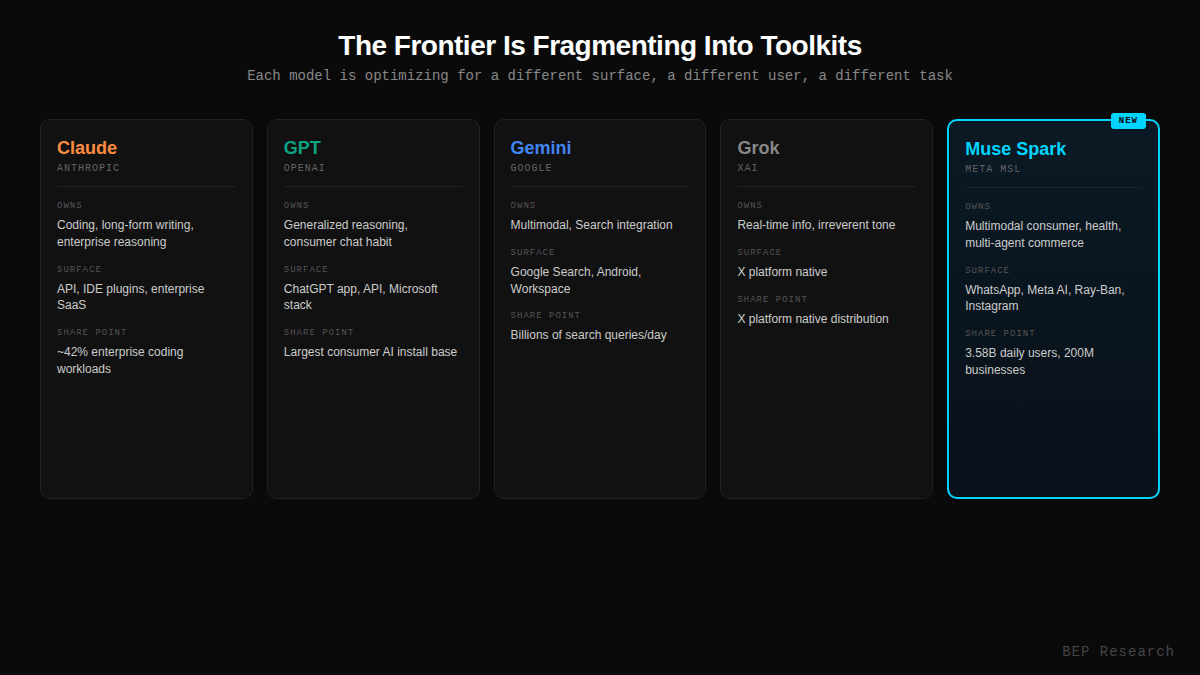
Each frontier model is now optimizing for a different distribution layer and a different class of user task. Claude owns coding and long-form writing at roughly 42% enterprise share in coding workloads. GPT owns generalized reasoning and the consumer chat habit. Gemini owns Google Search integration and the Android stack. Grok owns real-time information inside X. Muse Spark is positioning to own multimodal consumer reasoning and multi-agent commerce across Meta’s owned channels. “Best benchmark” matters less than “best model for the users and channels a platform already owns.”
Meta’s advantage is not that Muse Spark is the best model on paper. Meta says Muse Spark scores 58% on Humanity’s Last Exam and 38% on FrontierScience Research in Contemplating mode, competitive with Gemini Deep Think and GPT Pro. Both numbers need independent validation in the next 30 days. Even if the exact scores soften, the direction is enough: the gap to the frontier has narrowed to the point where Meta’s 3.58 billion daily consumers and 200 million businesses become the decisive variable.
The Surface Is the Moat, Not the Model
Benchmark leadership has become less valuable than product-channel fit. A model that is 10% better on a reasoning eval but has no consumer surface to run on is worth less, in practical monetization terms, than a good-enough model deployed inside a messaging app that 2 billion people open every day. The live interaction layer where consumers and businesses already communicate, transact, and get serviced is Meta’s structural advantage, and it is the reason a toolkit model optimized for that layer is more valuable than a generic frontier model sitting behind an API endpoint.
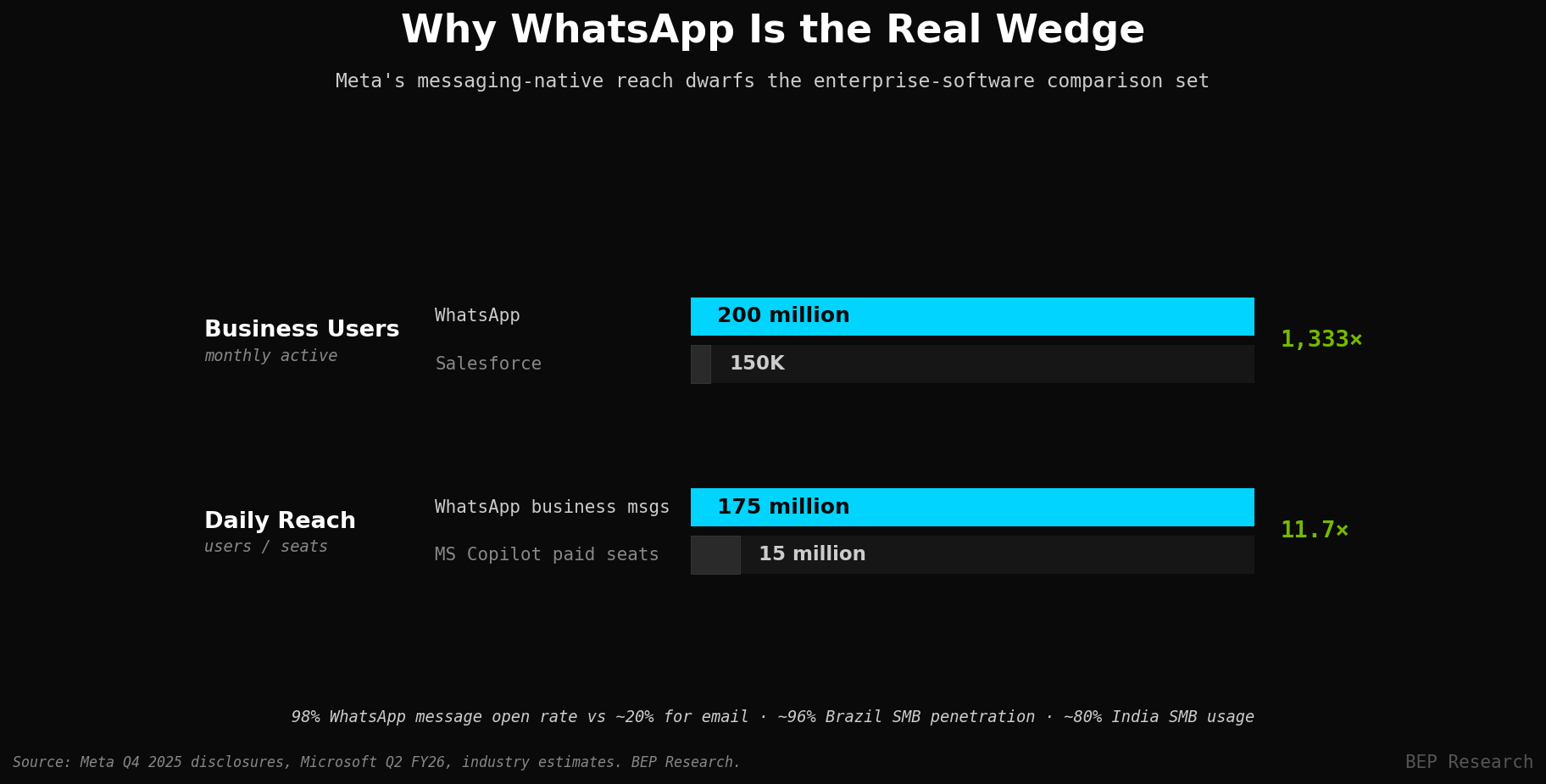
Meta disclosed that over 200 million businesses use its tools monthly. Salesforce has roughly 150,000 customers. That is a ratio of more than 1,300:1. Meta also disclosed that 175 million people message a business account on WhatsApp daily, while Microsoft reported approximately 15 million paid Copilot seats at year end. WhatsApp paid messaging crossed a $2 billion annual run rate in Q4 2025 per Meta’s earnings commentary. Click-to-message ads grew more than 50% year-over-year in the U.S. and 60% globally. These are disclosed metrics, not projections.
The geographic distribution matters as much as the raw scale. Industry surveys estimate roughly 96% of businesses in Brazil use WhatsApp as their primary communication tool and approximately 80% of SMBs in India rely on it for customer interactions. Penetration is similarly dominant across Germany, Spain, Nigeria, and South Africa. WhatsApp message open rates are near 98% versus roughly 20% for email. Many of these businesses will never touch a CRM. Their entire digital business runs through WhatsApp.
For enterprise sales intelligence in the Fortune 500, LinkedIn wins on structured professional identity. The U.S. enterprise software lens that dominates AI investment coverage is the wrong instrument for the market Meta is actually addressing. WhatsApp is not competing with Microsoft. It is competing with its own un-monetized installed base of four billion conversations.
The rest of this piece — including the three monetization vectors, the agentic commerce loop, the capex confirmation, and the price scenarios — is for paid subscribers.
The economic bridge from distribution to monetization runs through three revenue vectors, on three time horizons, with three different levels of inclusion in consensus estimates.
Near-term (next 2-4 quarters), partially in estimates. Advantage+ advertising improves as Muse Spark sharpens targeting and creative generation, expanding the ad multiple on a $200+ billion base. Click-to-message ads convert at higher rates as AI agents close the loop inside WhatsApp instead of handing off to a web form, expanding both volume and take rate. The sell-side partially models the ad uplift and mostly does not model the take-rate expansion. This is where the first incremental re-rate shows up.
Medium-term (12-24 months), not in estimates. Business messaging becomes its own line item where Meta charges for AI agent usage, transaction fees, or ARPU per business account. The current $2 billion annual run rate is the baseline. If that number accelerates meaningfully in the next two disclosures, the toolkit thesis moves from optionality into actual forward estimates.
Long-term (2-4 years), pure optionality. The terminal version is merchant workflow and payments capture: Meta owning not just the conversation and the ad, but the transaction execution, the order management, and the customer service software underneath. That is the platform outcome rather than the feature outcome. It is not in any model yet, but it is the scenario that justifies the highest terminal multiple.
The near-term vectors drive the first re-rate. The medium-term vector drives the second. The long-term vector is the one that turns META from an ad business with AI support into a messaging-native commercial platform.
The Dataset Advantage Is Real and Narrower Than It Sounds
OpenAI and Anthropic trained primarily on public internet text. Google holds search logs and YouTube, which is the closest competing consumer corpus. Meta holds something neither OpenAI nor Anthropic can replicate: roughly two decades of longitudinal, proprietary, multimodal signal from 3.5 billion active users across photos, video, messaging, and the social graph. The practical edge this creates is specific and bounded, not unlimited. It is not “Meta can build any model no one else can build.” It is this:
Identity resolution. Knowing which of two people in a photo is the user’s sibling versus a coworker is a problem every consumer AI product needs to solve. Meta has the ground-truth data to solve it.
Context continuity. A consumer AI assistant that knows what you bought last month, who you message on weekends, and what your last three vacations looked like is a different product than one that knows nothing about you at the start of every session.
Multimodal consumer grounding. Training a model to understand real human faces, homes, and everyday objects at the scale Meta has captured them produces better consumer and commerce recommendations than training on scraped web images.
Commerce signal. Marketplace transaction history, ad click-through behavior, and messaging intent combine into a behavioral dataset that is directly monetizable through agentic commerce.
The regulatory and privacy tension around this corpus is real and cuts directly against the deployment case. Cambridge Analytica, the $5 billion FTC fine, the active FTC consent order through 2032, and the €200 million DMA fine are all evidence that Meta does not get to use this data however it wants. Any aggressive deployment invites the exact regulatory response that constrains the use cases that make the dataset valuable. The asset is real. The permission to use it at full strength is not.
Scoped correctly, the dataset is a meaningful moat for consumer personalization, commerce recommendations, and multimodal assistance inside Meta’s own surfaces. It is not a moat for enterprise workloads, and it is not a moat Meta can exploit without regulatory pushback. Even inside those constraints, it remains one of Meta’s largest structural advantages relative to any Western frontier lab.
The Agentic Commerce Loop Is the Product
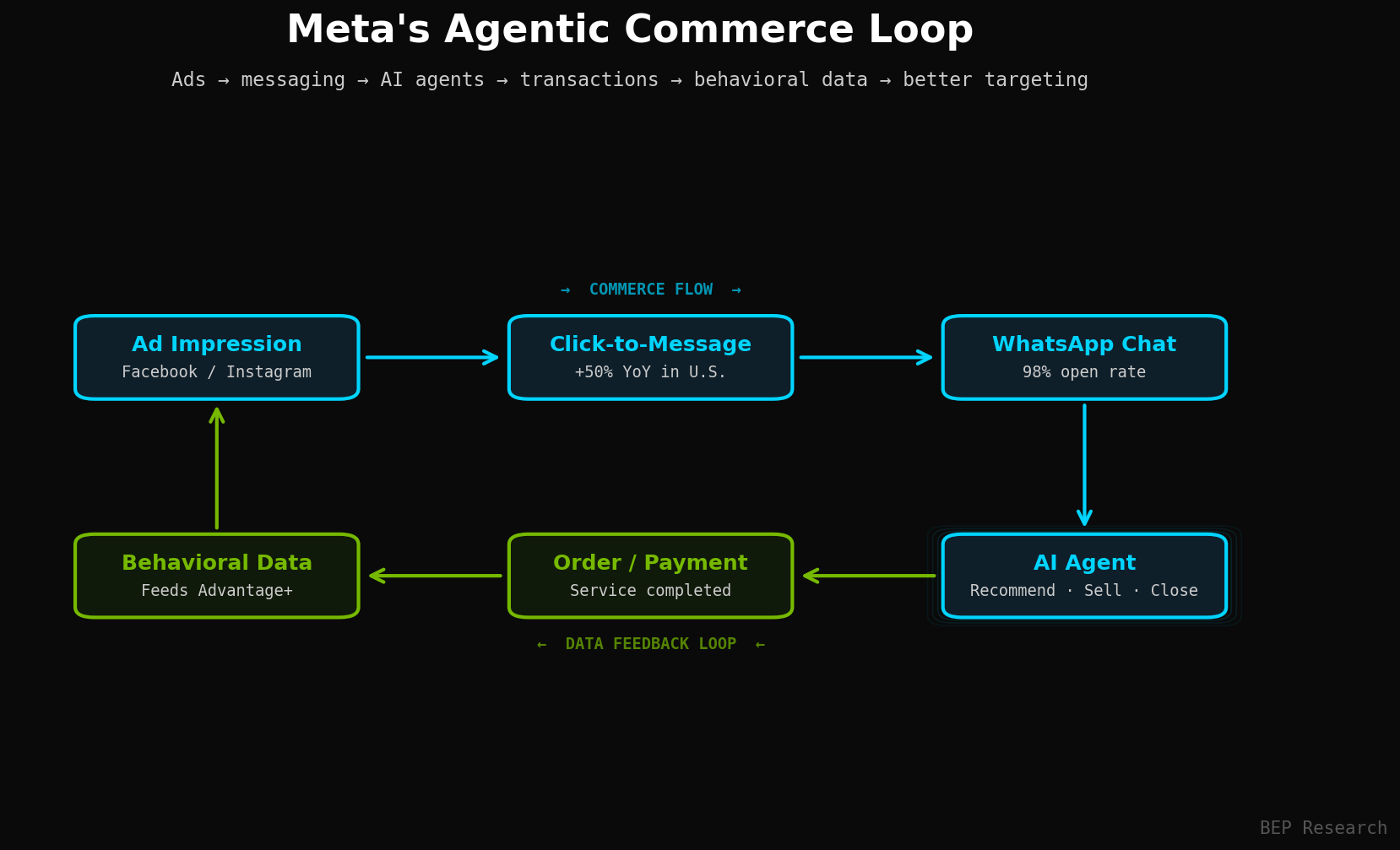
Meta disclosed that Business AI agents launched in October 2025 and drove 1 million+ weekly conversations in Mexico and the Philippines by Q4. The Manus acquisition, reported at $2 to 3 billion in December 2025, appears aimed at moving the platform from question-and-answer into transactable outcomes. In January 2026, Meta updated the WhatsApp Business API terms to prohibit general-purpose third-party AI chatbots, which makes Meta AI the default assistant on the platform. That is not a developer policy change. It is Meta reserving the agent layer for itself.
The end-state vision is one where AI-generated Advantage+ ads (roughly $60 billion in annualized run rate per Meta’s disclosures) drive clicks to WhatsApp, where AI agents close sales, process orders, and manage customer service inside the same app. Zuckerberg has said publicly that by the end of 2026 a business should be able to provide a URL and a budget and have Meta’s AI handle everything else. WeChat has already proven the messaging layer can evolve into a commerce platform at scale.
The economic hurdle is specific and worth naming. Owning the assistant layer only matters to the thesis if Meta captures transaction economics, service economics, or merchant software economics rather than just engagement. If the loop increases WhatsApp usage but the value accrues to the external payment processor, the external fulfillment provider, and the external merchant software, then Meta has built a better customer acquisition funnel for other people’s platforms. That is still accretive to the ad business, but it does not open the new revenue line the thesis needs.
The Infrastructure Confirms Real Demand
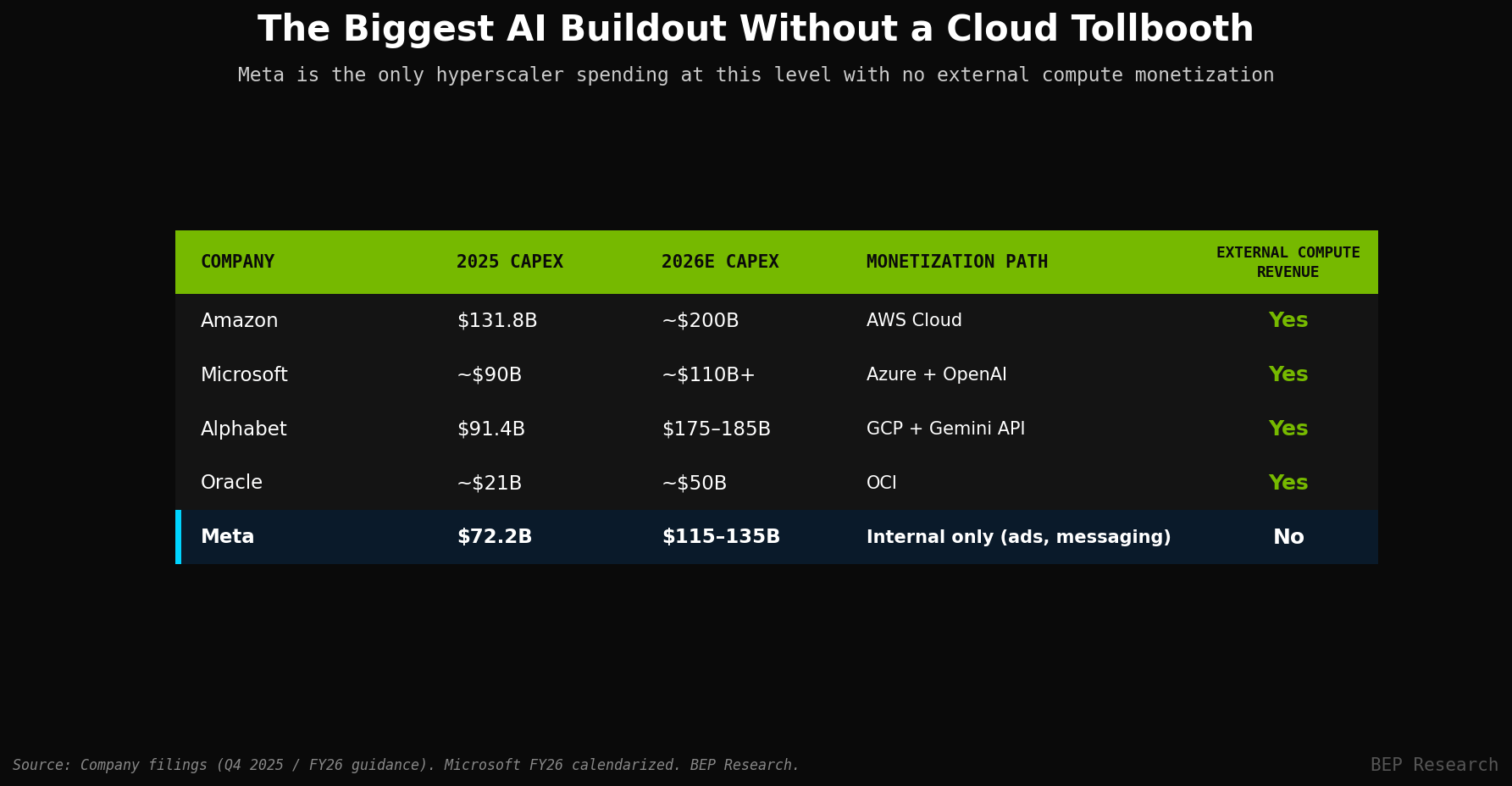
Meta is the only hyperscaler spending at this level without a cloud or API business to monetize the compute. Meta disclosed capex of $72 billion in 2025 and guided to $115 to $135 billion in 2026. Every GPU goes into a closed loop: no cloud revenue, no API revenue, no model licensing revenue. On paper this is the largest unmonetized AI capex commitment in the industry. The key question is whether that commitment reflects real internal demand or speculative overbuilding. Today’s infrastructure tape pushes the answer toward the former.
Two disclosures answer the demand question with external validation. CoreWeave announced today that Meta has expanded its existing agreement by $21 billion, bringing total contracted capacity to roughly $35 billion through December 2032, with early Vera Rubin deployments explicitly focused on inference rather than training. In March, Nebius disclosed a five-year commitment from Meta of up to $27 billion structured as $12 billion of dedicated infrastructure plus $15 billion of optional purchases, also anchored on Vera Rubin. Meta is renting capacity from the neocloud peer set because even its own record-scale buildout cannot satisfy the MSL roadmap. That is the single most important operational signal in the Muse Spark story, and it directly validates the thesis laid out in The NeoCloud Hypothesis.
The physical buildout reinforces the same read. Meta disclosed that Hyperion, its Louisiana AI campus, has expanded to 10 natural gas power plants delivering approximately 7.5 gigawatts, 240 miles of new transmission lines, and a $27 billion joint venture with Blue Owl Capital. That is more electricity capacity than the entire grid of South Dakota, committed to a single corporate campus. That does not fit the “expensive science project” framing that dominated the bear case two weeks ago.
Why It Could Fail
The deepest bear case is not about the model or the infrastructure. It is that Meta is an advertising company, and the same proprietary consumer corpus that makes its training substrate uniquely valuable is the asset regulators, enterprise security teams, and consumer advocates have spent twenty years trying to constrain. Cambridge Analytica, the $5 billion FTC fine for violating a prior consent decree, the active FTC consent order through 2032, and the ongoing antitrust probes into the WhatsApp chatbot ban in the EU, Italy, and Brazil are all early evidence of what the regulatory response looks like when Meta tries to exploit the dataset aggressively. For many enterprise buyers, Meta’s ad-driven data model is not a detail. It is the reason to say no.
The execution pattern reinforces the trust problem. Workplace launched in 2016, reached 7 million subscribers, and was shut down in May 2024. Reality Labs has burned $83.6 billion in cumulative losses per Meta’s disclosures, triggered a company rename, and absorbed 1,500 layoffs in January 2026. Meta’s AI organization has been restructured four times in six months. Llama’s enterprise share is thin: open-source LLM workload share in enterprise production contracted from 19% to 11% over 2024 and 2025 per independent survey data, and Llama holds approximately 9% versus Anthropic’s 42% in coding. Muse Spark is a partial counter, but it does not erase the pattern.
The structural risk that matters most has already been named in the agentic commerce section: Meta may own the top of the funnel while businesses refuse to let Meta own the system of record, the workflow engine, or the payments layer. In that scenario, WhatsApp becomes a powerful lead-generation wedge but not an agentic operating system, and Muse Spark’s capex justification compresses back toward the ad multiple rather than opening a new revenue line. That is the line this thesis has to cross.
More concretely, the thesis deserves a lower underwriting multiple if any of the following become visible over the next two to four quarters:
Engagement without monetization. Business messaging grows usage meaningfully but stays ad-adjacent only, with no standalone messaging revenue line in Meta’s disclosures.
Merchants keep the stack elsewhere. Payments, fulfillment, and software spending stay with Shopify, Stripe, and existing CRM tooling rather than routing through Meta, which caps revenue capture regardless of WhatsApp usage growth.
Regulatory tightening. Authorities in the EU, Brazil, or India constrain assistant placement or dataset activation harder than expected, which narrows the scope of the surface Meta can actually exploit.
Benchmarks without business outcomes. Muse Spark’s claims validate in independent testing but usage inside WhatsApp and Meta AI does not translate into measurable commercial wins, which leaves the model as a technical achievement without a commercial wedge.
Any one of these outcomes weakens the thesis. Two of them together would invalidate it.
What the Market Is Pricing
META bottomed at $526 on March 27 and trades around $628 now. What got repriced is the frontier model credibility gap. Two weeks ago the bear case was “$130 billion of annual capex into a late Llama 4 and a closed-source pivot that might not ship.” That version of the bear case is materially weaker today. Muse Spark exists. CoreWeave just committed to $21 billion of additional capacity through 2032. The Hyperion disclosure ties the infrastructure spend to a visible product roadmap. That is the re-rate from $526 to $620.
What has not been repriced is the distribution thesis. At roughly 20x consensus 2026 EPS, META still screens as undemanding for a business growing revenue above 20% with Family of Apps operating margins above 50%. The model credibility re-rate has happened. The toolkit re-rate has not.
The cleaner way to think about the valuation bridge is to ask what the current $620 level actually includes.
In the stock today: the core ad business, the recent multiple expansion from Muse Spark credibility, modest growth in click-to-message and business messaging as engagement features inside the ad funnel, and an easing capex discount.
Not in the stock today: any material contribution from business messaging as a standalone revenue line, any framework for monetizing the assistant layer beyond advertising, any credit for the proprietary dataset driving differentiated consumer products, and any terminal-value optionality on Meta owning transaction or merchant software economics.
That gap is the toolkit re-rate. The market has not closed it because the evidence is still strategic rather than financial. Muse Spark exists, Hyperion is real, and the CoreWeave print confirms demand. What still does not exist is a disclosed quarterly revenue line the street can plug into a model.
Base case. Muse Spark benchmarks hold in independent testing. Business messaging grows steadily but stays modest relative to the $200+ billion ad business. META trades $600 to $750 through year-end on ad multiple expansion as the capex overhang eases.
Bull case. Muse Spark’s multi-agent architecture becomes the engine behind WhatsApp AI agents. ARPU per business account climbs as agents handle sales, support, and ordering end-to-end. Business messaging reaches $10 to $15 billion in annual revenue by 2028, worth $40 to $80 per share at SaaS-adjacent multiples. Combined with ad multiple expansion, the stock trades back through the $796 all-time high.
Bear case. Muse Spark benchmarks do not hold up in real workloads. Meta drives WhatsApp usage but fails to capture economics beyond ads. Capex hits $135 billion and free cash flow compresses. The move off $526 partially reverses as the model credibility story fades and the structural trust problem resurfaces. This is the pullback I am waiting for.
What I’m Watching
I do not currently own META. I am looking to start a long-term position on the next meaningful pullback, whether that comes from a broader market reset, an independent Muse Spark benchmark miss, or the EU regulatory response outlined in the bear case. I am not chasing the $94 move off the March low. Four signals matter from here.
Q1 2026 business messaging revenue disclosure. The current $2 billion annualized run rate is the baseline. Above $2.5 billion annualized, messaging monetization is moving from optionality into a forward revenue line and the toolkit re-rate starts. Flat or modestly above baseline, the assistant layer is still primarily an engagement feature inside the ad business and the re-rate window narrows.
Independent Muse Spark benchmark validation. If Humanity’s Last Exam at 58% and the order-of-magnitude efficiency claim hold up in third-party testing inside 30 days, the model credibility re-rate sustains and the co-design payoff from MTIA is real. If either softens materially, META gives back a meaningful portion of the move off $526 and the pullback I am waiting for probably arrives.
Click-to-message ad revenue trajectory. Last disclosed at +50% year-over-year in the U.S. and +60% globally. Continued acceleration is the cheapest, fastest read on whether the WhatsApp wedge is widening. A clear slowdown is the earliest warning that the funnel thesis is weakening.
First MTIA plus Arm AGI CPU rack deployments inside Hyperion. Watch OCP for the rack spec release. If deployments become visible alongside disclosed usage or commercial wins on WhatsApp and Meta AI, the co-design story converts from slide deck into product. If deployments become visible without commercial capture, the market keeps reading the infrastructure as capex support for the ad business.
The shortest version: business messaging revenue and click-to-message growth tell me whether economic capture is starting. Muse Spark validation and Hyperion deployments tell me whether the underlying technology is holding. Both have to work for the full re-rate. If the first works and the second does not, the thesis is intact but the timeline stretches. If the second works and the first does not, Meta has built an impressive technical stack that fails to open a new revenue line, and $620 is approximately fair.
For much of the world, AI will not first arrive through a developer API or an enterprise seat license. It will arrive through messaging, commerce, and consumer assistance surfaces people already use every day. Muse Spark matters because it gives Meta its first plausible model family for that layer.
Resources
Press Releases & Primary Sources
Introducing Muse Spark: Scaling Towards Personal Superintelligence — Meta Superintelligence Labs official announcement, April 8, 2026 (benchmarks, Contemplating mode, scaling axes, Hyperion reference)
CoreWeave and Meta Announce $21 Billion Expanded AI Infrastructure Agreement — CoreWeave press release, April 9, 2026
Nebius Signs New AI Infrastructure Agreement with Meta — Nebius press release, March 16, 2026 ($12B dedicated + up to $15B additional, five-year term)
Meta Reports Fourth Quarter and Full Year 2025 Results — Meta Q4 2025 earnings (capex disclosure, $2B WhatsApp run rate, click-to-message growth)
Meta to Spend Up to $27 Billion on AI Infrastructure From Nebius — Bloomberg, March 16, 2026
Related BEP Research
The NeoCloud Hypothesis — The framework for why hyperscaler-to-neocloud capacity rentals are the most important operational signal in AI infrastructure. Meta’s CoreWeave and Nebius commitments are the largest validation of this thesis to date.
The Fourth Piece: Why Groq Changes the GTC Thesis — The toolkit framework: each frontier model is now optimizing for a different distribution layer and a different class of user task. Muse Spark is Meta’s entry into that pattern.
NVIDIA’s Inference Stack Depth Strategy — Why owning entire layers of the inference stack matters more than market share. The Hyperion buildout and MTIA roadmap are Meta’s version of the same play.
The Verification Gap: Who Audits the Agent Swarm? — The structural challenge facing any agentic commerce deployment, including the WhatsApp business agent loop described in this piece.
Is Software Dead? Who Survives When AI Eats the Premium? — The framework behind the 1,300:1 WhatsApp-to-Salesforce ratio: distribution-native AI eats traditional enterprise SaaS in markets where the SaaS layer never penetrated.
The Memory Wall: Why Groq and Jamba Had to Find Each Other — The co-design foundation that makes Muse Spark’s claimed efficiency gains plausible.
Disclosure: I do not currently hold a position in META. Positions disclosed: NVDA, LITE, CRDO, ALAB, TSEM, ORCL (2027 LEAPS), LSCC, BE. I am looking to start a long-term META position on the next pullback. This analysis is for informational purposes only and does not constitute investment advice.